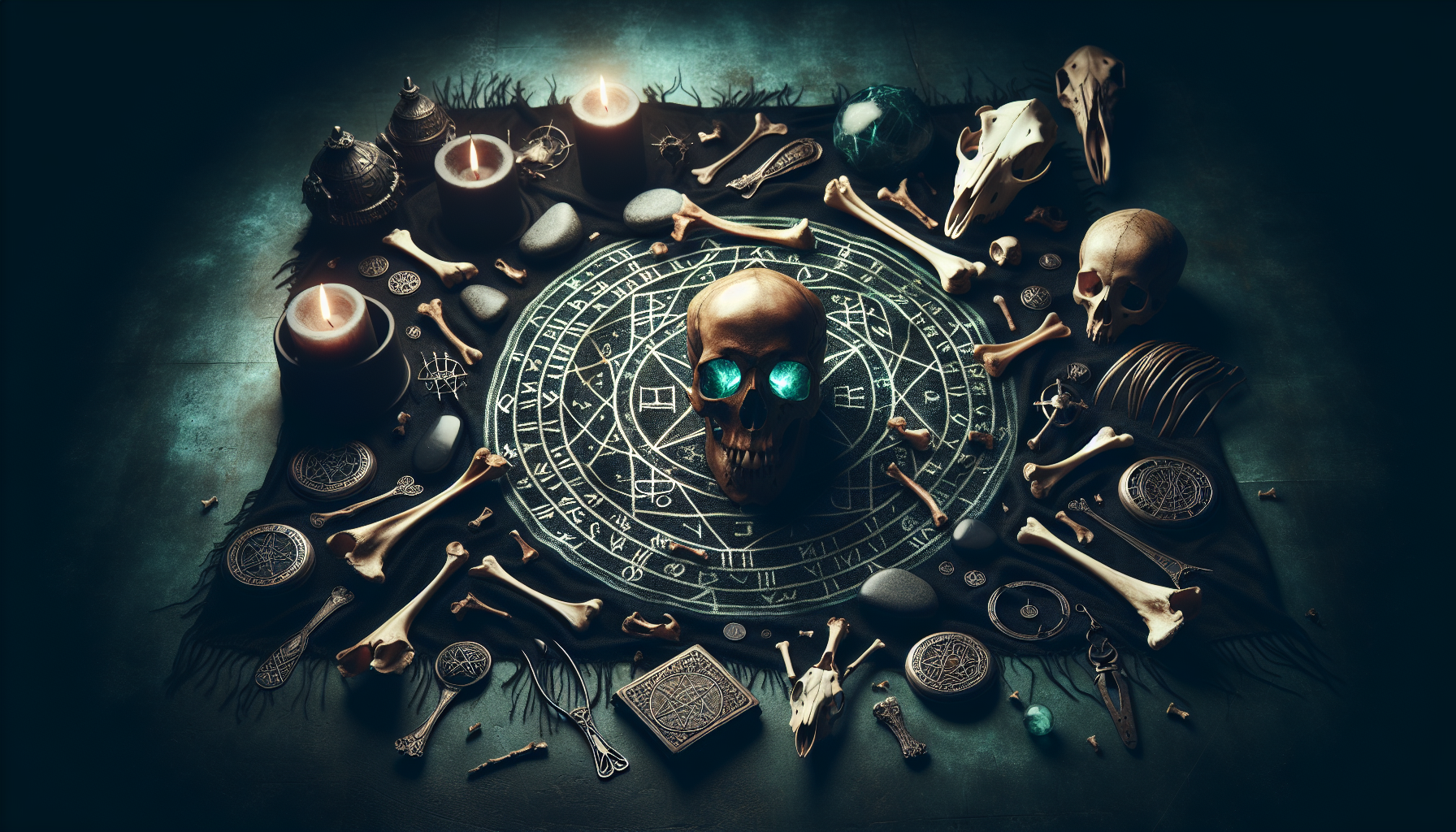

Part II: The Eight Schools
Osteomancy
The Art of Bone and Structure
Osteomancy — The Art of Bone and Structure
On the Architecture of Life
Bones are not what remain after life is gone. They are what life was writing toward all along.
Every heartbeat, every stumble, every stretch of limb is a line added to a manuscript you cannot see. Under the warmth of skin and the soft confusion of organs, the body is drafting something harder, quieter, and far more enduring. Cartilage thickens. Hollows deepen. Ridges sharpen. The skeleton is the final draft of the body, written slowly under the skin.
Osteomancy begins with this recognition: bone is not an accident. It is intention made mineral.
From that recognition follow three principles, as old as the first Bone Scholars and as precise as any theorem.
First: bone outlasts flesh because it carries purpose. Flesh feeds, feels, and decays. Bone remembers. It remembers how a creature stood against gravity, how it bore its burdens, how it prepared to fall. A ribcage is not merely a cage; it is a promise that something inside was worth guarding. A femur is not simply a lever; it is a record of every direction the body was willing to move—and the directions it refused.
Second: structure determines destiny. The way a spine curves, the angle of a hip, the breadth of a shoulder—these are not neutral facts. They are constraints that invite certain futures and resist others. A body built to climb will seek heights; a body built to kneel will find altars. Even buildings obey this law: a narrow stair, a low beam, a wide hall all dictate how lives flow through them. Osteomancy extends this truth from architecture of stone to architecture of bone.
Third: what supports us also constrains us. The same vertebrae that keep you upright forbid you from folding in half. The same joints that permit motion define its limits. Every brace is also a boundary. Every pillar is also a prison. This is not cruelty; it is the price of not collapsing.
These principles define Osteomancy’s domain.
Osteomancers read fate in skeletal remains: the splay of phalanges, the polish of a joint, the hairline fractures along a tibia. They listen with their fingertips. They trace how a life carried its weight, where it favored, where it faltered. They craft structures of protection from consecrated bone—arches that refuse to fall, thresholds that turn harm aside, circles that hold their shape against pressure from worlds unseen. And beneath all of it, they study the grammar of joints, angles, and load‑bearing lines.
To a layperson, a skeleton is a pile. To a practitioner, it is a sentence.
A joint is a conjunction: here, two possibilities meet and decide how to continue. A fused plate is a period: no more growth in this direction. A spiral in a horn or spine is a clause that loops back on itself, a life that repeats. The tilt of a pelvis, the spacing of vertebrae, the flare of a rib—each is a different part of speech in the language of form. Reading bones is reading syntax written in calcium and quiet.
Yet bone is more than language. It is threshold.
Every skeleton stands at the boundary between life and death. While flesh lives, bone is hidden, moving, bearing load, warm with blood. When flesh rots away, bone remains—bone‑white against ash‑black soil, still, and yet still speaking. It marks the crossing from motion to stillness, from breath to silence. In Osteomantic terms, each bone is a Threshold: a boundary between states—life and death, past and future, potential and aftermath.
Hold a skull in your hands and you feel it: the faint chill where warmth has gone, the echo of expressions that will never be made again, the hollow where breath once warmed the air. Your thumbs rest where eyes once watched. Your palm cups the curve that once held a voice. It is both artifact and doorway. Through it, a Bone Scholar looks not to call the dead back—that is Mortisophy’s concern—but to understand the structure of the life that was, and the shapes of endings still to come.
This threshold nature of bone reflects a deeper cosmology.
All structure in the Waking World exists where two primordial forces meet: Umbrael, the First Shadow, and Solareth, the Break of Light. Solareth pushes outward—growth, expansion, the urge to reach. Umbrael presses inward—weight, gravity, the insistence of limits. Between them lies the Veil, a thin, ink‑dark membrane where their conflict becomes form.
Bone is crystallized tension between these forces. Solareth demands that a limb extend, that a spine rise, that a hand open. Umbrael demands that the limb not tear itself apart, that the spine not topple, that the hand not fly to pieces under strain. Where they compromise, calcium salts settle along lines of force. Trabeculae in a vertebra trace invisible pathways of stress; the arch of a foot is a frozen negotiation between falling and standing. To read bone is to read the record of Umbrael and Solareth arguing across the Veil and, for a time, agreeing.
Osteomancers are those who have chosen to become fluent in this architecture.
They are Bone Scholars: analytical, patient practitioners who sit with remains the way others sit with books. They are comfortable with endings and with silence. Where another might smell only dust and old rot in a charnel house, a Bone Scholar inhales the dry, chalky air like library dust—shelves upon shelves of articulated histories, each spine literally a spine. They run careful fingers along old fractures, note the settling of a joint, trace the subtle thickening that speaks of a lifetime of carrying children, or stone, or fear.
In their hands, bones are not morbid trophies but texts. A scattered skeleton is a paragraph torn apart; an ossuary is an anthology. A cathedral’s buttresses, a city’s sewer tunnels, the arrangement of beams in an attic—all of these, too, become legible once you have learned to see structure. The world reveals itself as layers of support and constraint, every surface hinting at what it holds up and what it forbids.
If bones are the final draft of the body, then they are also its script. And Osteomancy, at its heart, is the decision to treat that script as language: to learn how to read what has been written in calcium and curve—and, in time, how to write new sentences into the architecture of life itself.
The Grammar of Bone
A skeleton is a sentence the body writes about itself.
Each bone is a word. Each joint, a mark of punctuation—comma, colon, question. Fractures and healed breaks are revisions, edits made under pressure. When Osteomancers speak of “reading the dead,” they are not being poetic. They mean it. Literally.
To a Bone Scholar, a skull on a table is as dense with information as a page of cramped handwriting; a full skeleton is an autobiography, written in calcium and time.
Begin with the long bones. Femurs, humeri, tibiae—the great levers of the body. These are the verbs of the skeleton, the grammar of intent and direction. A bowed femur that carried weight unevenly, a humerus thickened where muscle pulled at it for decades: these speak of where a life was pointed, what it pushed against, how it tried to move through the world. In Osteomantic notation, such bones are often marked with arrows and tense markers.
Past effort. Present burden. Future inclination.
Joints are the punctuation. Wherever bone meets bone, a choice has been made. Ball-and-socket joints—hips, shoulders—are generous commas, allowing wide arcs of possibility. Hinges—knees, elbows—are stricter marks, like colons and semicolons, directing motion along narrower paths. Ankles and wrists, with their small intricate bones, are the ellipses and dashes where movement hesitates, wavers, improvises. A fused joint is a full stop. An Osteomancer can trace the story of a life simply by following these marks from skull to toe: where the body flowed, where it stuttered, where it was finally forced to end a sentence.
Along the spine, vertebrae stack like clauses. Each one is a small, load-bearing word in the language of belief and burden. They show what a person has carried and what carried them. Compressed vertebrae speak of weights borne too long—physical labor, yes, but also postures of fear or deference held for years. A spine curved forward in a permanent bow may record decades of bending to authority or grief. A rigidly straight spine can signal discipline, stubbornness, or the calcified certainty of someone who would not bend even when they should have.
Ribs are the parenthetical phrases: guarded truths and vulnerabilities held close. They form a cage, but also a choir of thin, echoing bones that remember every breath. Fine, unscarred ribs suggest a life rarely struck or starved. Thickened, healed ribs tell of impacts, illnesses, pregnancies carried at cost. Subtle asymmetries can reveal which side a person turned toward in sleep, whom they curled around, how they braced against the world. To read ribs is to read what a life tried to protect.
Age, wear, and the smallest of fractures refine this grammar into something almost unbearably intimate. Under a practiced hand, bone becomes a palimpsest of repeated actions, ash-pale and whispering.
The roughened ridge where a tendon anchored and pulled, again and again, tells of a mason’s hammer or a scribe’s cramped quill. Micro-fractures at the ends of long bones murmur of years spent jumping from heights, or landing wrong but continuing anyway. Fine, spiderweb cracks in vertebrae speak of slow, grinding compression—too many hours at a loom, or in a chair, or beneath a pack that was never put down.
A Bone Scholar does not need to see the whole skeleton to read it. A single phalanx can betray a musician. A patella can confess a lifetime of kneeling. Even the density of bone—porous, brittle, or thick as stone—records diet, disease, and the quiet choices that add up to a life.
As you read this, your own bones are making such notes: tiny reinforcements where you favor one side, faint erosions where you ignore pain. Silent spider-cracks of habit. Mineral edits you will never see.
You are writing yourself, word by mineral word.
This grammar extends beyond individual bodies. Bones speak in chorus.
In ossuaries, graveyards, and the carefully arranged Bone Gardens, the placement of bones in space creates what Osteomancers call structural resonance. Rows of skulls stacked along a wall form a repeated refrain; femurs laid crosswise under a chapel floor establish a lattice of interlocking “sentences” that shape how sound carries, how people move, even how thoughts tend to settle in that place. Dust hangs in the air like ink-smoke. Footsteps echo off bone-white walls.
To walk into such a space as a Bone Scholar is to step into a paragraph already mid-sentence. The angles of the shelves, the rhythm of niches, the way weight is distributed through stone and bone together—these are syntax. You can feel where attention is meant to pause, where it is hurried along, where something is being emphasized or quietly buried.
Because structure can be read, it can also lie.
A structural lie is any deliberate alteration of bone or arrangement meant to conceal the true story. A grave where bones have been swapped or scattered to hide identity. A ribcage carefully broken and reassembled to erase signs of violence. An ossuary where certain skulls are buried deep and others displayed prominently to rewrite a history of power.
To an untrained eye, such deceptions hold. To an Osteomancer, they ring false. Density mismatches, unnatural angles, and tensions in the way weight travels through a structure all betray interference. Bones that have been cut rather than broken under strain, joints forced into alignments they never held in life—these are grammatical errors. The skeleton stutters where it should flow. A practiced reader can follow these hesitations back to their source, reconstructing not only what was changed but why.
Here Osteomancy stands in quiet opposition to Animasophy. Where Animasophers fracture the soul into fragments and decant them into crafted Vessels, Bone Scholars trust bones themselves as natural vessels of coherent identity—shaped slowly by a lifetime of structure and strain. Animasophic containers must be persuaded, bound, or forced to hold what is poured into them. Bones simply are what they have become.
For an Osteomancer, this difference matters. One art rearranges essence to fit an idea; the other listens to the architecture that already exists.
Much of what you have just read is codified—sometimes contradictorily—in a single, dangerous book: The Ossuary Codex. Bound in human bone, its thin-scraped pages smell faintly of dust and old lime. They diagram the grammar of bone in meticulous detail. Yet the Codex is notorious for refusing to stay still. Practitioners report that its diagrams rearrange themselves as their understanding deepens: joints that were once labeled as mere hinges gain new notations, ribs shift in illustration to reveal patterns you were not yet ready to see. Marginalia you do not remember writing appears in ink the color of dried blood.
Those who have read it carry its commentary etched invisibly into their own skeletons, legible only to other Osteomancers.
Theory, however, is only ever a scaffold.
You can memorize every term in the Codex, trace every diagram in ink-blue shadow, and still not truly understand. The grammar of bone is not fully learned on the page. It begins when a Bone Scholar lifts a femur from dust, feels its chill weight settle into their stiffening hand, and listens as the sentence of a life speaks through stone-made flesh.
Bone Reading: Divination Through Remains
The bundle is small enough to fit in a child’s hands.
Cloth, once white, now the color of old teeth, loosens under careful fingers. The bones inside spill onto the dark table in a muted rush: a soft, irregular clicking, like distant teeth chattering behind a closed door, or the first drops of rain on stone before the storm commits. They roll and settle, knocking gently against one another, finding their places.
The room holds its breath while they do.
This is Bone Reading: the signature working of Osteomancy. The art of asking bones to show you the structures that have been, the ones that are, and the most likely shapes of what may come.
Where Mortisophy crosses the Veil to speak with the dead, Osteomancy stays in the Waking World and listens to what is left behind. The bones themselves are enough. A skilled practitioner can work with a full skeleton laid out on a slab, a curated set of small, well-traveled fragments in a velvet-lined case, or a single finger-bone taken from a grave’s edge. The quantity matters less than the clarity of the structure and the precision of the question.
You are not asking, “What will happen to me?” You are asking, “What is the architecture of this choice? What loads does it carry? Where are its fractures already waiting?”
To attempt this working, three things are required.
First: bones cleansed and named. Cleansing is practical—removing clinging flesh, soil, and other noise—but also structural. You are stripping away distractions so that only the architecture remains. Naming anchors that architecture in your awareness. The name may be known and spoken (“Mariel, daughter of Sera, who died at sea”), or it may be as simple as “Unknown,” whispered with honest ignorance. The Ossuary Codex notes, in a margin that has survived three centuries and a war, that unnamed bones speak only in generalities.
Give them at least the dignity of a placeholder.
Second: a Threshold. Bone Reading is always performed at a boundary. A doorway with its frame of wood or stone. The edge of a grave where soil meets air. A chalk-marked circle on the floor, its line unbroken. Thresholds are where structures admit that they could have been otherwise. To sit at one is to acknowledge that you are about to step from not-knowing into knowing, from one possible arrangement of your life into another.
Third: your willingness to be changed by what you learn.
This is not metaphor. Osteomancy’s Price is calcification. Every working writes a little more rigidity into the practitioner’s own bones. To read too deeply and then pretend you have not heard is to invite a double stiffening: in body, and in the habits of thought you refuse to adjust.
With these in place, the methods vary.
For quick, shallow readings—weather, moods, the likely outcome of a single evening—practitioners favor knucklebones: small, irregular, eager to tumble. Held in cupped hands, warmed by breath, they are cast across a prepared surface: cloth, stone, bare wood. The pattern they make in that instant is a snapshot of tensions and supports, a sketch of the immediate structure of things.
For questions of direction—paths, careers, journeys—long bones are arranged along the cardinal points. A femur to the north, a radius to the east, a tibia to the south, a humerus to the west. The seeker’s token (a ring, a scrap of handwriting, a lock of hair bound around a chicken bone) is placed at the center. Additional bones are then cast or laid, their alignment relative to these axes mapping the pull of each choice, the likely load each path will demand.
For matters of lineage and events that span generations, vertebrae are laid in sequence, like a pale, segmented river. Each vertebra stands for a turning point: a birth, a betrayal, a law passed, a war begun. Gaps in the sequence mark lost histories. Extra vertebrae, interposed where they do not belong, may reveal intrusions—adoptions, imposters, secrets that have been supporting the family’s weight without acknowledgment.
Whatever the configuration, the interpretive principles remain the same.
Where bones fall in relation to each other matters. Proximity is entanglement. Two knucklebones that land touching, or a vertebra that slides hard against another’s edge, speak of lives or events so closely bound that to move one is to move the other. A long bone that lies alone, far from the main cluster, suggests an isolated factor—an influence that stands apart, carrying its own weight and refusing to share.
Orientation is equally telling. Bones that land inverted—knobs where smoothness should show, curves turned against their natural arc—speak of ruptures and betrayals, of structures forced to bear weight they were not designed to carry. A joint piece that twists away from its matching partner may indicate a choice that once aligned but has since slipped, leaving strain where there should have been ease.
And then there are the absences.
Missing bones are not gaps in information; they are loud silences. A skull absent from a family set may indicate a leader whose influence was erased. A missing vertebra in an otherwise complete spine can point to a generation whose story was deliberately broken. The Ossuary Codex devotes an entire shifting chapter to “The Reading of Hollows,” reminding the reader that what is not present can define a structure as surely as what is.
Consider a simple, common question.
A young practitioner—old enough to feel the pull of initiation, young enough to still share a table with their parents—comes to the bones with a decision: stay with their family in a small, predictable town, or leave for formal training in a distant city.
They bring a small pouch of mixed bones: four knucklebones, two finger-bones, a tiny vertebra from a bird. Their own baby tooth, kept by a sentimental parent, serves as the token.
At the kitchen doorway (a Threshold as real as any grave-edge), they spread a cloth and mark two directions: to the left, a chalk arrow labeled HOME; to the right, one labeled INITIATION. The baby tooth is placed between them. The hall light behind them throws a long, ink-blue shadow across the cloth, stopping just short of the bones.
The knucklebones are cast first. Two land close to HOME, touching each other and the tooth. One spins and comes to rest near INITIATION, slightly inverted, as if resisting the angle it has taken. The last rolls to the far edge of the cloth, alone.
The finger-bones are then laid deliberately: one bridging tooth and HOME, one bridging tooth and INITIATION. The bird vertebra is set above them all, like a small, fragile crown.
What does the practitioner see?
They do not see a command. The bones never say, “Go,” or “Stay.” Instead, they reveal structures.
On the HOME side: proximity and support. Two knucklebones pressed together, the tooth touching them both. This is a network of entanglements—family expectations, shared burdens, familiar walls. The finger-bone bridging tooth and HOME lies straight and aligned, an easy joint. Staying will distribute weight across many bones; the load of care and obligation will be shared. The structure is stable, but dense. There is little room for expansion without cracking something.
On the INITIATION side: a single knucklebone, inverted, near but not touching the tooth. The bridging finger-bone here is slightly misaligned; to rest in this position, it must twist. This suggests strain: the effort of reshaping oneself to fit into a new architecture—academy hierarchies, mentor expectations, the rigid schedules of training. The bird vertebra above both paths hints at lightness and motion that could be gained, but also at fragility. A fall could shatter more easily here.
And the lone knucklebone at the cloth’s edge, far from both? It sits at the border of the marked space, half in shadow, half in light. It is the unspoken option: neither home nor initiation as offered, but some third structure the practitioner has not yet named—running, refusing, or building a new Threshold elsewhere.
The reading does not decide. It makes visible the load-bearing lines of each choice. The practitioner will still choose, but they will do so with the knowledge of where the weight is likely to settle, and what might crack first.
For such a modest working, the Price is small but present.
As the bones settle and the practitioner leans over them, there is a familiar ache in their knees when they rise. A faint stiffness in their fingers as they gather the bones back into the cloth. The sensation is like cold seeping into old wood—subtle, but it does not leave. Deep readings—those involving full skeletons, complex spreads of vertebrae, or questions that stretch across generations—leave more lasting marks.
After a night spent tracing the spine of a dynasty, a Bone Scholar may wake to find their own back less willing to bend, their neck reluctant to turn fully. Joints that once cracked and eased now crack and stay. Calcification is not a metaphor; it is the skeleton’s answer in sympathy. The more you ask bones to reveal structure, the more your own structure commits to what it has already become.
[Marginal note, hand cramped but precise, attributed to Scholar Iresen of the Third Codex School]The danger is not that the bones will lie to you. It is that they will tell you the truth so clearly that you cannot pretend you did not hear it. The more often you ask, the less able you are to bend when the answer hurts.
There is, too, an ethical line, though Osteomancers phrase it in terms of structure rather than sin. Bones are not mere tools; they are the final architecture of lives. To disturb resting remains without consent or context is to tear down a house to inspect its beams while the last of the smoke is still cooling. Practitioners prefer bones already dislodged by time—washed from graves by river-flood, unearthed in construction, donated with intention. When they must lift bones from a settled resting place, they do so with offerings and promises: to learn, to protect, to return.
The eeriness is not in the act itself, but in the intimacy of touching what once held someone upright.
Once you learn to read bones, it becomes difficult to stop.
The patterns you see on the table echo outward. Doorframes become vertebrae of a house’s spine. Staircases reveal where weight gathers in a family’s habits. City walls read like ribs, guarding the soft organs of a population. You begin to see promises as joints, oaths as load-bearing beams, friendships as lattices that can shear under strain.
Some practitioners are content to cast and interpret, to whisper what the bones reveal and accept the slow, inevitable stiffening of their own. Others, having learned to read structure everywhere, grow restless with merely observing. They look at the architecture of lives and walls and futures and think, quietly at first and then with terrible conviction:
This could be better built.
They are the ones who stop at Thresholds a little too long. Who look at a stable structure and wonder how it might break. Or how it might be remade.
Ossuary Wards and the Binding of Places
An Ossuary Ward is a promise written in bone.
At its simplest, it is a protective working: consecrated bones arranged in deliberate patterns to anchor and redirect forces across a Threshold. Where Bone Reading listens to what has already been written, an Ossuary Ward writes back—fixing a structure into the Waking World so firmly that even unseen things must walk around it.
The bones themselves are rarely obvious.
In older houses, they sleep along doorframes: a thin seam of ivory beneath flaking paint, knucklebones tucked like beads into the lintel. In more cautious households, they lie buried in concentric rings beneath the foundation, a hidden echo of the floor plan pressed into damp soil and ash-black clay. Some practitioners prefer visible reminders: ribs and phalanges strung as wind-chimes along eaves, bone-white and clean, that never sway even in a storm. The wind passes through them.
Other things do not.
What makes a ward an Ossuary Ward is not merely the presence of bone, but the precision of its history and arrangement.
Each bone is chosen for what it has already held.
A soldier’s femur, set vertically into a gatepost, remembers endurance under weight and the forward drive of charge; it lends itself to defense, to standing firm against intrusion. The metacarpals of a midwife—cleaned, named, and bound together—are placed around thresholds where safe passage is needed: a birthing room, a surgery, a door that separates those who are ready to cross from those who must be kept back. A shepherd’s hyoid bone, once cradling a voice that called flocks home, can be hung above a cottage door to draw the lost back over its Threshold.
Then comes pattern—the grammar of the ward.
Circles bind and contain. Bones laid in rings—beneath a room, around a grave, along the perimeter of a property—create a closed loop of structure. What enters is held; what is held finds it hard to leave.
Lines guide. A run of vertebrae set like a spine beneath a hallway, or long bones inlaid in straight paths along floorboards, urges movement in one direction and sours it in another. People will find themselves walking the same routes without quite knowing why. They will call it habit. The bones will know better.
Spirals are the most dangerous.
A spiral of small bones, curling inward around a central point, invites transformation that cannot easily be undone. Whatever crosses that spiral’s center will not emerge unchanged. Many pages of the Ossuary Codex that diagram spiral wards are heavily redacted; the margin notes, where they survive, are terse:
Do not spiral what you are unwilling to lose.
To see how these principles work in practice, consider a simple ward: protecting a bedroom from intrusion.
A novice practitioner does not need human remains for this. Small animal bones are sufficient—a handful of mouse vertebrae, bird phalanges, the delicate ribs of a rabbit—provided they are cleaned, named, and thanked. To tie the ward to its sleeper, a personal bone-adjacent token is required: a baby tooth saved in a box, or a lock of hair braided around a chicken bone from a shared meal. These are not powerful on their own, but they carry the sleeper’s structure in miniature.
The Threshold must be clear. A bedroom door is ideal; a window can serve, if it is the primary point of passage. Smudged glass. A strip of worn floorboard where feet always land first in the morning. The place where in and out trade hands.
The practitioner begins by marking the Threshold—chalk along the sill, a whispered naming of “here” and “not-here.” The small animal bones are laid in a shallow arc just inside the door, vertebrae forming a low, invisible fence. The personal token is set at the arc’s center, binding the ward to the person rather than the room. The pattern is a partial circle, open inward: containment from the outside, freedom to move within.
Over the next nights, visitors will hesitate at that door. Intruders will find their steps slowing, their reasons to enter dissolving into a fog of “perhaps later.” The air at the Threshold will feel a fraction cooler, as if the room is holding its breath. The sleeper will notice that arguments which once erupted in the doorway now start further down the hall, or not at all.
They may feel safer.
They may also feel watched—not by an eye, but by the shape of the room itself. By the way the shadows gather just inside the arc and refuse to cross it.
For this is the deeper function of Ossuary Wards: they do not only bind places; they bind behaviors.
A well-laid ward subtly shapes how bodies move through space. Hallways become quiet channels where voices drop without conscious thought. Kitchens catch the heat of arguments; secrets drift toward stairwells and cellars, settling in the corners where bones have been sunk into joists. Children will avoid certain patches of floor, stepping around them with the unthinking precision of those who have learned a path that feels “right.”
Over years, a house with strong Ossuary Wards develops habits.
Doors that were once used regularly become symbolic only. Certain chairs are never sat in. Guests find themselves lowering their voices near particular walls, even if they do not know why. The structure remembers, and in remembering, it guides.
And once a house learns a habit, it is reluctant to let it go.
It is tempting to compare this to Hematurgy’s Crimson Covenant, where two souls are bound so that they share fate and wounds. The resemblance is superficial.
Hematurgy works in blood and soul: it knits the unseen, making pain and destiny flow between living vessels. Osteomancy binds bodies, spaces, and lineages through structure. An Ossuary Ward does not care who you are, only how your bones fit the pattern it has been taught. A Crimson Covenant might ensure that if one partner bleeds, the other scars; an Ossuary Ward, laid across a family home, ensures that everyone who grows up beneath its beams will learn to walk the same paths, carry the same burdens in their spines.
Some practitioners attempt to combine the two—Crimson Covenants sealed inside Ossuary Wards, blood-oaths anchored to bone geometry.
The results are rarely subtle.
The ward begins to favor some bodies over others, drawing covenanted souls together and excluding the rest. Houses become traps. The air grows thick, metallic, like old blood on iron. Families twist into closed loops of obligation and hurt, unable to admit new structure without tearing the old apart.
Even Bone Scholars, who pride themselves on dispassionate analysis, write of such experiments with a single word in the margin:
Mistake.
More perilous still is the temptation to bring Mortisophy into the pattern.
The Threshold Key—carved from the first bone of someone who died peacefully, attuned to the Veil between the Waking World and the Bone Gardens—is a Mortisophic artifact by origin. Used on an ordinary door, it opens passage into that cultivated plane of endings.
Used within a properly laid Ossuary Ward, it does something stranger.
For a brief span of heartbeats (and the Key always takes those heartbeats as its Price), the warded space becomes a hybrid Threshold. The bones in the walls remember not only the structures they have known, but the Gardens from which all endings are seeded. Practitioners report standing in their own rooms and seeing, superimposed upon familiar furniture, rows of pale trees bearing vertebrae like fruit, pathways paved with skulls worn smooth as river-stone by centuries of passing feet. The air smells of dust and dried flowers and the faint, clean cold of bone.
In that overlap, bones can be asked questions they would not otherwise answer. Lineages can be traced not just backward, but sideways—into the shapes of deaths not yet chosen. It is a powerful joint working of Osteomancy and Mortisophy, and most Bone Scholars condemn it as reckless.
They are not wrong.
Every use of the Threshold Key within a ward not only shortens the bearer’s life; it drags the ward itself a little closer to the Bone Gardens. Houses so treated grow very quiet. Sound dies in the corners. Shadows lengthen in ink-blue strips along the floor. Things that enter do not always feel the urge to leave.
Sometimes, neither do the people.
The Price of all this is not paid by the house alone.
Every Ossuary Ward a practitioner lays writes a little more structure into their own bones. At first, the changes are welcome: a steadier stance, a sense of where to place their weight in any room. Their habits sharpen into rituals—always checking the hinges, always counting steps between Thresholds, always touching the same spot on the same doorframe before sleep.
Over time, spontaneity becomes difficult. They sit in the same chair, walk the same route, speak the same phrases when beginning a working because that is how it is done.
Calcification is not only in the joints; it is in the patterns of days.
Advanced ward-weavers are easy to predict. They arrive at the same hour, lay tools out in the same order, eat the same meals before major workings so their bodies feel “correct” in the pattern. Their friends know which topics will always be avoided, which paths through a city they will never take. In binding places into safe, comforting repetitions, they have let those repetitions grow inside themselves.
Protection, after all, is a kind of cage—one that closes as much around the builder as around what they mean to keep safe.
And yet, if you can bind a place with bone, you can also build with it. Some Bone Scholars take that literally.
They are the ones who stop merely warding houses, and begin designing them.
The Scaffold: On Constructed Servants
The first time you watch a Scaffold rise, your mind will reach for the wrong word.
Necromancy.
Loose bones lie scattered on cold stone: a femur here, a clutch of ribs, a spill of phalanges like pale seeds across slate. At a word, they stir. At a second, they begin to find each other, clicking together along invisible lines of intention. In a handful of breaths, there stands before you a thing that was not there—a temporary, obedient structure: servant, guardian, tool.
You must understand this or nothing that follows will be safe:
No soul is called to wake it.
This is not Mortisophy. No spirit is coaxed back across the Veil. No memory is disturbed in the Bone Gardens. The Scaffold is pure Osteomancy—structure and purpose, nothing more. It moves because you have written motion into its joints. It obeys because you have described obedience in the grammar of bone.
A typical Scaffold is ugly in a way that leans toward beauty. It is all skeleton and no pretense of flesh: spindly, unfinished, with gaps where muscle and tendon ought to be. Vertebrae stack slightly out of true, lengthening the spine into an insectile arch. A ribcage may be narrowed, compressed, made into a cage for nothing at all.
When it moves, it wastes nothing. Every step is a problem solved in the most efficient way. No sway, no flinch, no unconscious adjustment. The joints are over‑articulated, like a teaching diagram that has unfolded itself and stepped down from the page. Where eyes should be there are only empty sockets, yet somehow you feel watched—measured, weighed, assessed for load.
The Ossuary Codex devotes an entire fold‑out to such constructs: ink‑blue diagrams of possible Scaffolds, arms and legs and torsos splayed out around a central axis, each bone annotated with its ideal stress tolerances in cramped funeral purple. To build one is to translate those diagrams into the Waking World.
The process begins with selection.
You do not simply grab whatever bones are at hand. Strong, load‑bearing pieces—femurs, tibiae, segments of spine—form the primary supports. For fine manipulation, you gather phalanges and metacarpals, the small clever bones of hands and feet. Ribs become braces and curved struts; a pelvis, split and inverted, becomes a stable base.
Laid out around you on ash‑dusted stone, they resemble an alphabet you are only beginning to sound out.
Next comes arrangement. You consult the Codex, its vellum pages whispering as you unfold the diagram relevant to your purpose: bipedal bearer, quadrupedal brace, multi‑limbed lattice for holding a ceiling that no longer trusts itself. The diagram does not show a creature; it shows force paths—lines of weight and counterweight, angles of compression and tension inked in tarnished gold. You follow these, fitting bone to bone until the pattern in the book and the pattern on the floor agree.
Only then do you speak.
The binding phrases are not poetry. They are descriptions, stripped to structure:
“You will stand beneath weight not exceeding [specified measure]. You will not move from this marked boundary. You will hold until the stone above you settles, or until I release you.”
The more precise your language, the cleaner the working. Vague wishes produce vague supports. Vague supports fail.
When you finish the last phrase, the bones tighten against one another. A shiver runs through the construct. It stands.
A Scaffold is not alive, and it is not clever. It cannot improvise. It will not catch a falling cup unless “preventing lateral displacement of unsecured objects” is part of its described task. It follows the structure it was given, nothing more. If you forget to tell it to stop, it will hold until your focus breaks, or until its form collapses from accumulated strain.
All Scaffolds are temporary. That is both safety and limitation. When the task is complete, the binding loosens. The construct sags, then comes apart with a soft, anticlimactic clatter, bones rolling back through the dust to their inert anonymity. No ghost lingers; no will remains.
Consider a common use.
A ritual must be performed in a cellar whose ceiling has begun to fracture. The air smells of damp stone and old lime. You cannot risk collapse—the threshold you are opening will not tolerate sudden change. So you gather bones: ox femurs for strength, hog ribs for curved bracing, a scatter of chicken bones for fine adjustments where the stone is most uncertain. In the dust beneath the weakest span you lay out a low, many‑legged Scaffold according to a Codex diagram titled, in ink‑faded script, “On the Bearing of Untrustworthy Loads.”
You describe its purpose in exacting detail: the weight it must support, the points of contact, the duration, the way it will distribute pressure along its spine. When you speak the last word, the construct rises into place, pressing its back of interlocked vertebrae against the cracked stone. The fissures in the ceiling stop widening. Throughout the working, dust sifts down in a thin, constant veil onto bare bone and goes no farther.
Or another: a sick relative who cannot walk must be carried through a haunted pass, a Threshold where the dead take an interest in the living. The wind there smells like cold iron and old breath. You dare not call on Mortisophy; you will not give the watching dead an excuse. Instead you build a narrow, gentle Scaffold—a low frame of ribs and arm bones, padded with cloth, designed only to bear and to follow. Its task is simple: move from this door to that stone, keeping its burden level, stopping if the heart it carries falters.
It does exactly that. No more. No less.
Useful. Reliable. Obedient.
Utility has a price. In Osteomancy, the Price is always calcification.
Each time you assemble a Scaffold, you are teaching your own skeleton something. You are rehearsing the act of bearing weight, of locking joints, of becoming a brace. The lesson does not remain outside you.
After your first few constructs, you may notice that you stand a little straighter when you concentrate. Your knees prefer not to bend fully. Your shoulders set themselves as if expecting a load. As your practice deepens, your bones thicken along familiar lines of strain; scans will show dense ridges where there were none, pale as bone‑white chalk on ink‑dark images. Your range of motion narrows. Your “natural” posture becomes a brace position you never consciously chose.
[Marginal note, hand cramped and angular, attributed to a Scholar now fully calcified]The first time I realized I was standing like my own Scaffold, I laughed. Back straight. Knees unbending. I have not quite stopped standing that way since.
This is the quiet horror beneath the awe. Every construct you build outside yourself is mirrored, slowly and inexorably, within your own body. The world learns to lean on what you make. Your bones learn to become what the world leans on.
One day, there may be no difference.
On Calcification: The Price of Structure
The price of Osteomancy is calcification.
Every working writes a little more rigidity into your bones. Every Bone Reading, every Ossuary Ward, every scaffold laid in The Waking World is paid for in stiffness and lost motion. The Ossuary Codex is blunt on this point: structure does not appear from nothing. Something must harden to hold it.
At first, the changes are easy to ignore.
Morning stiffness that lingers a little too long. Knees that need a few extra steps to remember how to bend. Fingers that no longer quite meet palm to palm when you clench a fist. You blame the cold. The chair you study in. The long nights over bone-fragment diagrams and ink-smudged vellum.
You tell yourself this is what dedication feels like.
You notice, too, that your days begin to arrange themselves.
You start to prefer schedules, rituals, predictable paths through the city. The same corridor to the library. The same seat in the lecture hall. The same cup, the same pen, the same route home through ink-blue shadow. At first this feels like discipline. Then it feels like comfort.
Only later do you realize it is also constraint.
Calcification is slow. That is its mercy—and its trap.
As practice deepens, the body keeps pace. Bones thicken on scans and in scryings. Fine trabecular webs inside your femurs grow denser, whiter, the color of bone dust on black cloth. Joints lose cartilage; the spaces between surfaces narrow until bone almost kisses bone. The spine straightens and refuses to bow. Slouching becomes effort. You stand like a pillar without thinking about it.
The mind follows the skeleton’s lead.
Patterns become addictive. You see the same load-bearing lines in bridges, in families, in empires. Improvisation feels dangerous, almost painful, like stepping onto a floor you have not tested. You find yourself finishing others’ sentences—not out of arrogance, but because their conversational structure is so obvious you cannot help but predict it.
Some practitioners stop here.
They accept a little stiffness, a little ritual, in exchange for the ability to read the world’s hidden joints. They retire early. They teach. They walk slowly, but they still walk.
Others do not stop.
Advanced calcification is not metaphor. It is a state.
Practitioners become living statues: bodies so rigid that movement beyond the smallest increments is impossible. At first they lose the easy motions—running, kneeling, turning quickly. Then the fine ones—writing by hand, buttoning a shirt, brushing hair. Eventually, some can move no more than their eyes. A few pass even that threshold, their gaze fixed, their thoughts the only thing still in motion.
In that stillness, their structural sight becomes unparalleled.
They read the “architecture” of a room, a person, a city with a glance. They can feel, without moving, which beam in a house is one season away from rot. Which vertebra in a visitor’s spine will fail first. Which law in a nation’s code is the true load-bearing clause. Their minds become ossuaries of pattern, ordered and precise.
These are the Bone Scholars in their final form.
The archetype has been with Osteomancy since the Age of First Practitioners: analytical, ritualistic, patient. Comfortable with remains, with endings, with silence. Their flaw is written into their gift. Progressive calcification. Loss of flexibility in thought and body. Their fate is to become oracles of structure—consulted for centuries across the Modern Era, but unable to step across even the smallest threshold.
They do not walk to their students; their students come to them.
Consider one such visit.
A young practitioner—joints still loose, mind still willing to improvise—climbs the narrow stairs of an old archive. Dust hangs in the air like pale ash. The wood smells of dry rot and old ink. On the top floor, in a room where the boards never creak, waits a revered Bone Scholar.
They cannot turn their head to greet the visitor. The neck has fused into a perfect column. Only their eyes move, sliding with slow precision to mark the newcomer’s entrance.
The room is arranged perfectly around their immobile body.
Shelves radiate like ribs from the chair where they sit. Within arm’s reach—though the arms no longer lift—are ledgers, diagrams, fragments of bone set in labeled trays the color of tarnished gold. The light falls from a high window at such an angle that, at all hours, it illuminates whatever a visitor places upon the central table. No furniture blocks a path; there is nothing here that would require the Scholar to twist or lean.
They have become the fixed point, and the world has bent to accommodate their stillness.
The young practitioner lays a bundle of bones on the table. The Scholar’s eyes track the arrangement without blinking. When they speak, the voice is low and rough with disuse, each word measured: describing not just what the bones say, but how the beams of the building answer, how the practitioner’s own stance reveals where they will crack first. The consultation lasts an hour. When the young one leaves, their knees ache on the stairs in a way they cannot quite explain.
The ache does not fade quickly.
Knowledge transforms the knower. Power has a price. The immortality of stone is not the same as living.
A calcified Bone Scholar may endure from the closing years of the Age of First Practitioners into the late Modern Era, watching generations come and go while their own body barely changes. They do not age as others do; they weather. Hair leaches to bone white, skin to the color of old parchment. They are not spared decay, only motion. Their endurance is a kind of monument, not a reprieve.
Why, then, would anyone accept this fate?
Because once you see the world’s bones, it becomes very hard to look away.
And once you start to harden, it becomes even harder to stop.
Opposition and Synergy: Souls, Time, and Destiny
Osteomancy begins with a conviction: identity is architecture.
To a Bone Scholar, a life is something that slowly builds itself into coherence. Each decision thickens certain beams, abandons others. The skeleton is the final floorplan, drafted beneath the skin. Bones remember what they were asked to hold.
Animasophy begins elsewhere. It treats the self not as a single structure, but as a district—rooms that can be sealed off, subdivided, moved into new buildings entirely. Where Osteomancy reveres coherent structure, Animasophy fractures and redistributes the soul. Identity becomes divisible, reconfigurable, a set of fragments that can be recombined into new arrangements.
This is why the two schools regard each other with such unease. To an Animasopher, Osteomancy’s devotion to wholeness looks like voluntary imprisonment. To a Bone Scholar, Animasophy’s soul‑splitting looks like taking a chisel to the load‑bearing walls of a cathedral.
Nowhere is that offense clearer than in the Sundered Spirit Rite.
You will find only a redacted summary in these pages, and even that may unsettle you. The Rite is an Animasophic working that shatters a soul into deliberate fragments, each bound into a separate vessel. It is spoken of as liberation: one fragment to suffer, one to remember, one to remain untouched.
To Osteomancers, it is blasphemy. The Sundered Spirit Rite takes the very coherence they cherish—the single, continuous structure of a life—and explodes it. Some Bone Scholars refuse to even read the theoretical notes, leaving those leaves of the Ossuary Codex deliberately unmarked, the vellum still bone‑white where their ink should have darkened it. One marginal hand, cramped and nearly illegible, has simply written: This is not repair. This is collapse.
The disagreement runs deeper than aesthetics. It is a dispute over vessels.
Bones are natural vessels, shaped over a lifetime by pressure, habit, and accident. They are containers grown from within, their capacity defined by the life that filled them. An Osteomancer trusts such vessels because they are earned; every ridge and thickening testifies to history. Old bones smell of dust and cold iron and something faintly sweet, like dried blood rubbed thin.
Animasophic vessels are artificial. Glass phials etched with sigils, masks, mirrored boxes, living hosts prepared to hold a shard of someone else. They are made first, then asked to accept contents that did not grow there. Even when the Rite succeeds, these vessels often reject their cargo. Leaks. Hairline fractures in the psyche. Whispers that slip out through ink‑fine cracks. The Bone Scholars point to these failures as proof: structure that does not grow with its contents will eventually crack.
Yet Osteomancy is not defined only by what it refuses. It is also shaped by what it cannot resist collaborating with.
Chronurgy—the art of time and branching possibility—finds in bone a perfect anchor. Where Chronurges see timelines as fluid, sliding past each other like ink‑blue currents, Osteomancers offer them structures that have already endured centuries. Ancient femurs, fossilized vertebrae, ossuaries whose arrangements have survived wars and weather: all become texts that can be read across eras. Dust lies thick in their hollows. The air around them tastes stale, as if even breath is reluctant to disturb what has already settled.
In joint workings, a Chronurge traces the branching paths of history while a Bone Scholar identifies the “load‑bearing events”—the moments without which the entire structure would collapse into an entirely different world. Together, they map not every possibility, but the key beams that held.
From such collaborations emerged a working that stands with one foot in the forbidden.
Its name is not recorded in full; the diagram in the Codex is blacked out in three places, the binding phrases reduced to initial letters. Ash‑black rectangles swallow what once was written. What remains is enough to glimpse the intent: to fix a lineage’s destiny by anchoring it to an ancestor’s bones and a specific moment in time.
The procedure, insofar as it can be reconstructed, is simple in concept. The bones of a chosen forebear—one whose life exemplified the desired pattern—are placed at the center of a Chronurgic circle. Candles burn low and guttering, their smoke staining the ceiling like faint funeral purple bruises. The practitioner identifies a single moment in that ancestor’s history: a vow kept, a betrayal refused, a threshold crossed with courage instead of fear. That instant is seized, described in bone‑grammar and time‑notation, and then driven like a nail through the family line.
The promised benefits are intoxicating. Stability. A lineage protected from certain futures: cowardice, treachery, collapse. Children not yet born will feel an instinctive pull away from those paths, as if guided by invisible braces. Their spines will stiffen at the thought of betrayal. Their tongues will stumble on lies. They will step back from certain thresholds without ever knowing why.
The danger is quieter, and far more complete.
Calcified destiny.
Once the anchor is set, no one in that line can truly change course. They may think themselves free, but every attempt to deviate meets invisible resistance—opportunities that never quite appear, courage that fails at the crucial second, chance meetings that always redirect them back toward the ancestral pattern. Lovers arrive late. Doors close early. The right word dries to dust on the tongue.
The line endures, but only as a repetition.
Some Chronurges call this mercy. Many Bone Scholars disagree, but not all. The temptation to make a structure safe, even at the cost of motion, lies very near the heart of Osteomancy’s sin. You can feel the pull of it, can’t you? The thought of never failing in the one way that terrifies you most. Of being braced from within.
The Bone Gardens complicate this further.
Mortisophers teach that bones in the Waking World are seeds scattered from that other plane, each carrying a potential shape of ending. To them, a skeleton is not only a record of what was, but a hint of how death might have wished to flower. When Osteomancers arrange bones, when they prune ossuaries into clean patterns and erect wards that channel endings along certain paths, some Mortisophers accuse them of gardening too aggressively.
“You would turn the wild cemetery into a courtyard,” one Mortisophic gloss complains in the margin of the Codex, the ink smeared as though the writer’s hand shook. “Neat rows, trained vines, no room for the strange volunteer. Fate is not meant to be this tidy.”
The Bone Scholars reply, when they reply at all, that every building requires pruning. That without load‑bearing choices, the world collapses into shapeless ruin. That even the Bone Gardens have paths.
It is in these advanced workings—where bones, souls, and time are bound together—that the Ossuary Codex grows most evasive. Diagrams blur at the edges, as if the ink itself is trying to retreat. Steps are struck through, or replaced with ink‑black bars. Whole folios have been excised, leaving only stubs of thread in the binding and a faint rectangle of cleaner vellum where pages once lay. The redactions in this chapter mirror those absences deliberately.
Some structures are too dangerous to describe in full. Some destinies are too easy to envy.
There is one final speculation whispered among Bone Scholars: that the Codex itself is such a structure. A composite skeleton of theory and diagram, grown over centuries of practice. Those who study it long enough report that its pages rearrange, that its marginalia answer questions the main text did not pose. The book seems to learn its reader. Its spine creaks differently each time it opens, as if adjusting.
If that is true, then the Ossuary Codex is not merely a record of Osteomancy, but a working in its own right—one that calcifies understanding along certain beams, strengthens some conceptual joints while letting others atrophy. As you read it, you do not simply learn how to shape the world’s bones.
It is shaping you, deciding what in you will bear weight, and what will quietly be allowed to break.