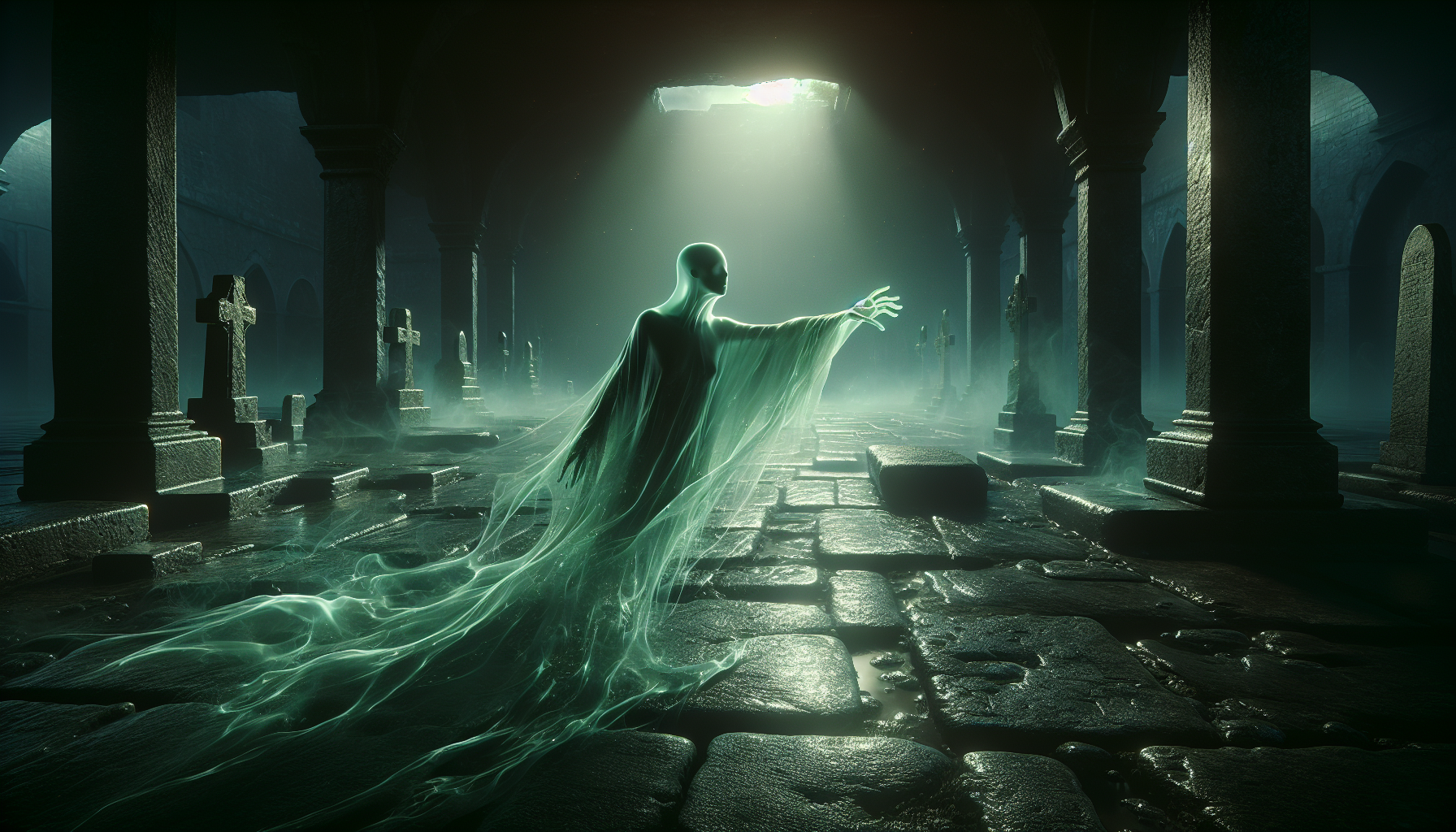

Part II: The Eight Schools
Mortisophy
The Art of Speaking with Death
Mortisophy — The Art of Speaking with Death
Not Necromancy: What Mortisophy Really Is
You have met necromancers before, even if only in stories.
They are the bullies of the dead. They drag corpses from their rest, wire tendons with will, and make what is left of a person stumble and twitch just to prove that they can. Their art is loud: clacking bone, jerking limbs, the reek of old meat forced into one more march.
Mortisophers do not do this.
We knock.
We wait.
We step—only when invited—as guests into death’s domain, and we understand that we are the ones out of place.
Do not confuse us, a thin hand has scrawled in the margin, ink faded to the color of old bruises. The dead know the difference. They remember who yanked their bodies upright, and who only asked to speak. —Pale Listener, Modern Era
Mortisophy is the art of speaking with death. Not with meat. Not with animated remains. With endings themselves, and with those who have passed through them.
Its philosophy rests on three simple, brutal principles:
- Death is not the opposite of life, but woven through it. - The dead speak truth because they have nothing left to lose. - Every ending fertilizes a beginning.
If you cannot accept these, you will never be more than a tourist at the edge of the grave.
Death woven through life means you are never far from the Threshold. Every breath is a boundary: in, out, in, out—tiny rehearsals for the last one. Mortisophers train themselves to feel that hidden strand, to sense where life thins and where endings have taken root. A battlefield still tasting of iron on the air, a hospital ward humming with fluorescent fatigue, the quiet room where a single old woman died peacefully sixty years ago—each thrums differently to a practiced ear.
The dead speak truth, not because they have become saints, but because the usual incentives have fallen away. Reputation, punishment, reward—these belong to the living. In the Bone Gardens, where endings grow, there is only what was, and what remains of it. Lies require a future to maintain. The dead have none.
Every ending fertilizes a beginning. This is not comfort; it is structure. A life ends, and its choices seed consequences in those who remain. A city falls, and from its ruins new customs rise like weeds through cracked stone. A question is asked of the dead, and the answer—if you survive it—will change how you live the time you have left.
Mortisophy concerns itself with these exchanges. It does not raise bodies. It does not parade skeletons. Its workings move along the seam between the Waking World and the Bone Gardens, never mistaking the husk for the harvest.
When you practice Mortisophy, you do not pull the dead back into flesh. You go to them, or you draw their presence near, or you carry a controlled echo of their certainty into an object. Thresholds, not puppets. Voices, not marionettes. Transformation, not display.
If something is walking around in your grandmother’s skin, a sharper, older ink notes at the page edge, the strokes pressed so hard they’ve nearly torn the vellum, you are not speaking to your grandmother. You are speaking to whoever thought that was a good idea. —Pale Listener, Era of the Bone Gardens
Before we go further, we need shared language.
You are a Practitioner if you work any of the Umbral Arts. If you choose Mortisophy, you are binding yourself to a particular understanding of endings: that they mean something, that they cannot be undone without cost, and that listening to them will change you.
A Working is a specific magical operation—a way of touching death’s domain with intent. Threshold Walking is a Working. The Final Question is a Working. A Memento Mori, crafted to show a likely death, is a Working bound into bone or glass, ink or ash.
The Price is what you pay for every Working. This is not metaphor. In this world, power is accounted for in blood, in memory, in years. No Working is free. Mortisophy is simply more honest about how it tallies.
A Threshold is any boundary between states: life and death, seen and unseen, now and then. Mortisophy stakes its practice on the greatest of these—the line between the Waking World and the Bone Gardens—but once you learn to feel that edge, you will notice lesser thresholds everywhere. A closed door in a hospice, cool metal under a sweating palm. The silence after the last heartbeat. The first moment you realize you are not alone in an empty room.
The archetype who embodies this art is known as The Pale Listener.
You will see their notes throughout this chapter: cramped script in the margins, ash-smudged warnings, the occasional line crossed out so hard the page fibers tear. The Pale Listener is any Mortisopher who has spent so many hours in conversation with the dead that the living begin to look temporary by comparison. They speak to the dead with casual familiarity. Their wisdom is grounded in others’ trauma. They are unafraid of endings.
They also die young.
You will be tempted to think you are different, one Pale Listener writes in a hand that trembles slightly, ink pooling darker where the quill hesitates. That you will manage your consultations wisely. That you will save your years for questions that “truly matter.” I thought so as well.
We have not yet spoken plainly of why.
For now, understand this much: Mortisophy’s Price is measured in your life. Every conversation with the dead—whether you cross into the Bone Gardens or merely brush the Threshold from your side—costs you a measurable piece of your remaining time.
A minute of whispered confession from a lost lover is a minute less you will ever have to spend with the living. An hour wrung from a murdered witness is an hour carved clean from your future. The arithmetic is exact. The universe does not haggle.
You will not feel yourself dying on the spot. The heart does not burst, the lungs do not seize. Instead, you will notice the absences: the missing heartbeats, the subtle deepening of lines at the corner of your eyes, the quiet bone-deep fatigue that settles in the joints like winter and never quite leaves. Mortisophers learn to count in such losses.
At first, you will shrug it off, a margin note assures you, the ink here gone a tired, washed-out gray. Everyone is tired. Everyone ages. Only later, when you compare your reflection to your years, will you realize how much you have already spent. —Pale Listener, Modern Era
This is not meant to frighten you away.
If you are still reading, something in you already leans toward the Threshold: a question you cannot leave alone, a grief that will not soften, a hunger for truths only the dead can safely carry. Mortisophy will answer such hungers, in its way. It will also make you pay for every mouthful.
If you still wish to listen, you must first understand where the dead go to grow.
The Bone Gardens: Where Endings Grow
The first time a Pale Listener stepped through, she thought she had gone deaf.
No wind. No insects. No distant city-noise. Only the faint, soft grind of her own steps in soil that wasn’t soil at all, but ground bone—fine as flour, pale as spilled milk. Each footfall released a whisper of dust that climbed her ankles like fog and clung there, cool and patient.
The air tasted of dust and rain: that metallic coolness of a storm about to break, laid over the dry chalk of old teeth. She breathed in endings with every inhale. When she exhaled, the Gardens did not stir.
They were already full.
Pale blossoms rose from the bone-loam in quiet rows. Some were the color of old parchment, some a bruised ink-blue, some so white they seemed to glow from within, as if lit by something buried deep below. When she brushed her fingers along a petal, it did not feel like plant-flesh.
It felt like paper that remembered being skin.
For a moment she heard something—no, not heard, remembered hearing. A child’s laugh, cut short. A song unfinished on a held breath. A final, shuddering exhale that never quite reached air. Each blossom held an ending, curated and complete.
She had expected horror. Rot. Screaming.
Instead she felt… safe. As if nothing here would ever surprise her again. As if every story had already been told, and her only task was to listen.
She did not notice, until much later, how hard it was to make herself turn back.
*
The Bone Gardens are not hell.
They are not heaven, either. No judgment. No reward. No punishment. They are a plane of existence adjacent to the Waking World, a domain where endings are cultivated like flowers in orderly beds. Every death in the Waking World leaves an echo; those echoes root here. They are tended—not by gardeners you could name, but by the quiet, organizing will of death itself.
Think of the Waking World as soil still full of growing things: unfinished lives, unresolved stories, choices still unfolding. The Bone Gardens are what remains when the growing is done. Stems clipped. Seeds counted. Petals pressed between pages.
Mortisophy calls this place home.
Practitioners do not drag the dead back into their bodies. They go where the dead have gone, or they draw that place closer, working at the Threshold between the Waking World and the Gardens. Every Working of Mortisophy, from Threshold Walking to the Final Question, brushes that plane in some way.
You cannot practice the art without, sooner or later, feeling bone-dust under your feet.
The relationship between the two planes is not symmetrical. The Waking World is where you live, where The Price is paid in heartbeats and years. The Bone Gardens are where those payments are recorded—carefully, permanently, in ash-gray ink.
Most of the time, the boundary between them—The Veil—is firm. You feel it as a pressure at the edge of sleep, a shiver at the moment of almost-falling, the way a room grows suddenly quiet when someone dies. The Veil is the membrane between states, the skin between life and death, waking and ending.
Mortisophy exists to touch that skin without tearing it.
But there were times when the membrane thinned.
There are places in the Waking World where the bone-loam presses up against cobblestone and root. Old battlefields. Plague pits. Cities that loved their dead too much to let them go. In such thin places, the Gardens bleed through: a white flower pushing up between cracks in the pavement, a cold patch of air that smells like rain over dust, a corner of a hospice room that is always, inexplicably, quiet.
These are remnants of the Era of the Bone Gardens, when the boundary did more than thin.
It buckled.
Boxed Historical Note: The Era of the Bone GardensThere was a time when Mortisophy ruled.
In that era, Pale Listeners and their patrons treated the Veil as a suggestion rather than a law. Cities built consultation halls where the dead were summoned in shifts. Courts tried cases with dead witnesses. Councils planned wars with advice from those who had already died in the last one.
The Price was paid in thousands of shortened lives, but for a while, no one cared. Knowledge flowed. Endings were cross-examined, catalogued, traded.
The Veil thinned under constant pressure. The Bone Gardens expanded into the Waking World: blossoms of memory pushing up through floorboards, streets that led—if you walked them at the wrong hour—into rows of bone-white trees instead of familiar markets.
Eventually, the boundary recoiled. The Veil hardened. Whole consultation halls vanished overnight, swallowed by the Gardens they had abused. The generation that had spent itself on mass conversations died within a decade.
We live in the echo of that recoil. Modern practice is quieter. The Gardens, however, remember.
— marginal note in ash-gray ink, attributed to a surviving Pale Listener of that era
In the present age, you will usually approach the Bone Gardens deliberately, through a Working. You may cross fully (Threshold Walking), or call a single voice across (the Final Question), or anchor a sliver of their certainty into a Vessel (Memento Mori). In every case, you are pressing against The Veil.
You should know how the rules change when you are on the other side.
Time, in the Bone Gardens, feels softened. Not absent—there is still sequence, still before and after—but it does not bite. Moments stretch like ink in water. A conversation that would cost you an hour of your life in the Waking World can feel like a lingering afternoon among the rows, the sky overhead a constant, dim ash-black, edged in ink-blue where it meets the horizon.
The dead you meet there do not appear as they died.
They appear as they understand themselves.
A man burned in a theater fire may greet you in his best coat, smelling faintly of smoke but untouched by flame, because he never accepted the manner of his death as part of his story. A woman who spent her life pretending to youth may meet you as she finally allowed herself to be: hair white as bone-dust, eyes clear and unafraid. A child who never reached adulthood might choose a body somewhere in between, wearing the height they imagined they would have grown into.
This has consequences. When you speak to the dead, you are not consulting an objective record. You are walking through a garden of self-curated endings. Their truths are sharp, but always filtered through the shape they have chosen to keep.
Lies, in such a place, are difficult.
The Bone Gardens rest under the distant governance of Solareth’s domain of revelation: what is hidden tends to surface, what is twisted tends to straighten. The dead have nothing left to protect but their self-understanding. To fabricate an entirely new story is like trying to graft a foreign flower into bone-loam that rejects it. Most cannot. Their tongues stumble. Their forms flicker. The Gardens themselves seem to disapprove.
Omissions, however, are easy.
A dead king can tell you, truthfully, where he hid his enemies’ bodies and never mention what he did to his own children. A murdered scholar can recite the formula that killed her without adding that she invented it. They will not always see the gaps as deception. To them, the parts left unspoken may simply not be part of the “ending” they have chosen to preserve.
You will feel this as a kind of hollow space in their testimony. A pause where something should be. A flowerbed with one row missing.
The Gardens will not fill those rows for you.
If all of this sounds strangely gentle, that is because it is. The Bone Gardens are peaceful. The air is cool and dry. The sky rarely changes. There is no hunger, no pain, no weather but the soft suggestion of rain that never quite falls. Endings, once planted, do not struggle.
They simply are.
This is their danger.
Terror drives you back to the Waking World. Horror sends you scrambling for the warmth of your own pulse. The Bone Gardens offer neither. They offer rest. They offer the quiet certainty that nothing more will be demanded of you, that your story has already been told as completely as it ever will be.
For a practitioner already weary of paying The Price in heartbeats, that quiet can feel like mercy.
The longer you walk the rows, the more your body in the Waking World forgets why it should keep fighting to breathe. The more you listen to the dead, the more their stillness seems preferable to your own restless hunger. Many who are lost in the Gardens are not dragged away.
They simply sit down among the blossoms and decide, without words, that they are finished.
The Veil does not argue.
It is only a membrane, after all. A boundary, not a judge. It yields to your choice as readily as it yields to your Workings. Mortisophy teaches you how to press your hand against that boundary, how to slip through without tearing it, how to come back with your pockets full of endings you did not have to live to earn.
But you should remember, before you learn the techniques, that gates swing both ways.
To enter a garden, you need a gate. Mortisophy offers three.
Three Gates: Thresholds into Death’s Domain
All Mortisophy workings, no matter how ornate their sigils or elaborate their preparations, do one of three things.
They approach the Threshold.
Some step through it. Some drag it closer. Some break off a splinter and carry it away.
Everything else is ornament.
When Mortisophers speak of the Threshold, we are not being poetic. Threshold is a technical term: the boundary between states, most often the thin, resisting membrane of The Veil that separates the Waking World from the Bone Gardens. To work Mortisophy is to touch that membrane—lightly, recklessly, or with something like respect.
Across the centuries, Pale Listeners have come to agree on three primary approaches. We call them gates.
Not because they are safe, but because they open.
Threshold Walking: Dying on Purpose
Threshold Walking requires three things: a place where death has occurred, something the dead valued, and the absolute certainty that you want to return.
You can improvise almost anything else.
Not these.
The place may be simple: a hospice bed where someone died with a hand held, a crossroads where an accident tore metal and bone, the quiet corner of a garden where a beloved animal was buried. Mortisophers call these steeped places—soil and air that remember the last exhale.
The anchor must be personal. An object the dead cherished, or a vow they would have believed. A ring worn thin, a recipe written in their hand, a promise spoken aloud and meant. It is the line you throw across The Veil so you have something to follow back.
And the certainty is yours alone.
If you are not sure you want to return, the Bone Gardens will notice.
Whenever possible, you do not Walk alone. In the Era of the Bone Gardens, apprentices died by the dozens trying. Modern practice insists on supervision: another Practitioner sitting with your body in the Waking World, fingers on your pulse, ready to drag you back with pain, with your shouted name, with the bitter reek of smelling salts. The Price is yours, but the watching is theirs.
Some cheat. They carry The Threshold Key: a sliver of bone carved from someone who died peacefully, polished to a soft, oily sheen. Turned in any lock, it opens onto the Bone Gardens directly. It makes the crossing easier. Cleaner.
It also brings you one step closer to your own death with every use, measured in heartbeats lost.
Most Pale Listeners learn to Walk without it.
The Final Question: Truth from a Single Mouth
The Final Question is not a walk among the blossoms of the Bone Gardens. You do not drift past a hundred shades and listen for whatever will speak back.
You choose one dead soul.
You bring them to you.
You pay.
Where Threshold Walking moves your awareness across the Veil into death’s domain, the Final Question pulls a single thread of the Bone Gardens through into the Waking World. It is a Working of calling, not visiting: a summoned interview with one specific dead person, bound to answer one thing you must know.
To perform it, you need three anchors.
First: the name. Not a title, not a description, but the name by which the dead knew themselves. The more precise and intimate, the tighter the call. A murderer’s full birth name will draw more cleanly than “the Butcher of Greybridge.”
Second: a strong sympathetic link. This may be an object the dead valued, a drop of blood from their direct descendant, or soil taken from the place of their death. The Bone Gardens grow from endings; anything that remembers the moment of ending will serve as a root.
Third: the question itself.
This last is where most practitioners fail.
The question must be shaped with legalistic care. It must be singular—no compound clauses, no “and then,” no hidden branches. It must be narrow enough to be answerable, yet wide enough to encompass what you truly seek. You will speak it aloud once, at the moment the shade arrives. You will not be permitted to rephrase.
The rule is simple:
One question.
One answer.
The dead, when called in this way, may not lie. This is not kindness. It is alignment. Their state is bound to Solareth, the Break of Light—the primordial force of revelation and separation. In death, all masks have already been stripped away. There is no reputation to defend, no punishment to fear, no reward to earn. They have nothing left to lose.
But truth is not the same as clarity.
A shade may answer literally and let you drown in what you did not think to specify. It may answer with omissions, leaving the most painful edges in silence. It may answer in metaphor, offering an image that is perfectly true and perfectly useless to a desperate mind.
“Where is the knife you used?” is a different Working than “How can I prove you killed her?” Both will be answered truthfully. Only one may save a life.
The Price is as exact as the rule.
From the moment the dead first speaks until the moment its answer is complete, your life is shortened by every heartbeat that passes. Not “about” that much. Not “rounded” to the nearest minute. The tally is precise. Each thud in your chest is one you will never live again.
The dead know this.
They are under no obligation to be brief.
Some are brisk, still shaped by mortal habits of conversation. Others luxuriate. They have all the time that remains to you, and no stake in conserving it. The more tangled the question, the more intricate the answer, the more they may stretch.
Consider a common application: a practitioner is contracted by families of the missing. The killer is dead—executed, perhaps, or killed resisting arrest. The bodies were never found.
The practitioner prepares carefully. The name is known from court records. The sympathetic link is a length of rope used in the last murder, still faintly stained a dried-blood brown. The question is rehearsed until it can be spoken without tremor:
“Where are the bodies of every person you killed, in sufficient detail that they can all be found and identified by those who search?”
The circle is drawn. The rope is coiled at the center like a sleeping serpent. Chalk dust and ash-smear cling to the practitioner’s fingers. The name is spoken, once, with the weight of the Working behind it.
When the shade arrives, it does not look like a monster. It looks as it understood itself: a tired man in work clothes, hands calloused, eyes empty. His outline wavers like ink-blue smoke, but his gaze is steady. He regards the practitioner without malice.
Without anything at all.
The question is asked.
The answer begins.
The dead man describes the first burial site: the exact bend in the river, the distance from a particular ash tree, the depth of the shallow grave measured in his own handspans. He recalls the smell of the soil—cold, wet, iron-rich—the way the moonlight fell on the stones he used as markers. He pauses often, searching for details. He corrects himself. He insists on precision.
Heartbeats pass.
He moves to the second victim. The field behind the mill. The broken fencepost. The way the ground sank slightly over time. He remembers the pattern of his own boots in the mud and offers it as a reference. His voice does not shake when he speaks of lifting the bodies. It does not change at all.
Heartbeats pass.
There were thirty-three.
By the time he reaches the last, the practitioner’s hands have begun to tremble with age. Joints throb with a slow, grinding ache. Muscles drag with the heaviness of years that have not yet technically occurred. Hair has gone thin and bone-white in the space between one description and the next. Skin hangs looser over knuckles that had been smooth at the start of the Working.
The voice that asked the question had been that of a person in their thirties. The breath that receives the final word is that of someone well past sixty.
The families will find their dead. They will have names for their grief. The practitioner will lose decades of unspent mornings to give them that.
In the Era of the Bone Gardens, when Mortisophy dominated and death-cults treated the Bone Gardens as a public forum, Final Questions were performed en masse. Councils convened rows of Pale Listeners in ink-dark halls, each bound to a single shade, each tasked with extracting some necessary truth: the locations of plague pits, the confessions of war criminals, the secrets of vanished treasuries.
A marginal hand from that time, ash-smudged and cramped at the edge of a cracked vellum page, notes:
We thought ourselves efficient. One Listener, one shade, one question, repeated a thousand times across the empire. We mapped rivers of bones, catalogued atrocities, settled disputes no living witness could answer.We also buried an entire generation of Mortisophers in bodies that looked forty years older than their birth records. They died with clear ledgers and empty futures.
Modern practice is more restrained. Timers are set—ink-black sand in narrow glass, calibrated to cut conversations short. Questions are narrowed to minimize elaboration. Apprentices are forbidden to ask anything that might tempt a story.
Still, the temptation remains. There are questions that cannot be softened without losing their point.
“Did she love me, at the end?”
“Where did you hide the child?”
“What truly waits for us beyond the Gardens?”
Each of these is a Final Question someone has already died for.
You may think, reading this, that you will be clever. That you will craft the perfect, compact query. That you will end the conversation the moment you have what you need.
You will not.
When the dead begin to speak, you will lean closer. You will ask them, with your silence, to go on. You will trade years for one more detail, and then another, until the air tastes of dust and your pulse is a drum you cannot slow.
Ask only what you are willing to die for.
The dead are patient.
Your heart is not.
Memento Mori and the Weight of Knowing Your End
A Memento Mori is not a metaphor.
In Mortisophy, the term names a specific Working of the Carrying gate: an object into which a practitioner has anchored a controlled echo of death’s certainty. When you hold it correctly—when you let it look back at you—it shows you your own death.
Not a whimsical possibility. Not every branching path of fate.
The end that waits if you change nothing.
The form is almost incidental. Mortisophers have used whatever the Waking World will bear as a Vessel for that echo. A hand mirror whose silver backing has been dusted with ash from the Bone Gardens. A ring with a splinter of funerary bone ground so fine it passes for ordinary white enamel. A charm carved from the knuckle of a peaceful dead, worn bone-cool against the throat. A page of ink-blue script that remains blank until you press your thumbprint into the margin and dare to look away.
The craft is always the same underneath. Through the Carrying gate, the practitioner presses the chosen object against the Veil at the moment of someone else’s ending—a vigil at a natural deathbed, the air thick with morphine and last words; a watch over a battlefield gone quiet, flies buzzing over cooling armor; a night spent in the Bone Gardens beside a row of closing flowers, earth still loose over new graves. They invite a sliver of that completed ending to settle in the Vessel, binding it with oaths and the slow drip of their own heartbeats.
The Price is paid in advance. Every stroke of inscription. Every whispered binding. Every minute of contact with the Threshold. Each one shaves life away in thin, invisible curls.
The finished Memento Mori does not kill its bearer. Not directly. It simply brings their death closer in sight, the way the Threshold Key brings the Bone Gardens closer in space.
Kin artifacts, both of them—designed to make the far-off intimate.
Using a Memento Mori is deceptively simple. You hold the object as instructed. You steady your breathing. You focus on the question you think you are asking—how do I die?—and you let the echo answer.
The glimpse is brief. A heartbeat, perhaps three. Never more than a few breaths. In that span you may see a scene with painful clarity: the angle of light through a cracked window, dust turning in the beam like slow-falling ash; the pattern of fractures in a road beneath your knees; the face leaning over you as your chest refuses to rise. Or you may receive only symbols: a recurring number on a clock face; a river overflowing its banks; your own hands stained in a color you do not yet recognize, spreading like ink through water.
Mortisophers argue about how much of this is literal. The dead do not think in the straight lines of living time, and the echoes they leave in a Memento Mori often prefer metaphor. But the Working’s reputation endures because, when left unaltered, the death it shows is almost always the death that comes.
There are rules, if you value what remains of your years.
First: you do not stare. The longer you force the vision, the more violently it snaps back—leaving you with nosebleeds, migraines, and the unsettling sense that you are half a step to the left of your own life.
Second: you do not look often. Each consultation with the dead shortens a practitioner’s life by the length of the conversation; each consultation with your own ending does something subtler. Repeated viewings do not shave off hours in neat, countable segments. They erode. Sleep frays. Joy dulls to a funeral purple gray. The future feels thinner, even if no visible years have yet been lost.
A marginal note from a Pale Listener of the Era of the Bone Gardens reads:
I have seen three who looked every month. Two died as shown. One died trying not to.
And yet, some lives bend for the better under that weight.
Consider a modern Mortisopher, apprentice to a cautious school. Her Memento Mori takes the shape of a bone-white ring, given as a graduation test rather than a toy. When she finally dares to use it, she sees herself old—truly old—sitting in a sunlit courtyard, breath rattling, hands ink-stained, surrounded by students arguing gently over some point of ritual. Shadows pool cool and ink-blue beneath the benches. There is no violence in it. Only exhaustion, and a quiet satisfaction.
She weeps when the vision releases her. Not because it is terrible, but because it is so ordinary. So reachable.
She stops chasing every dangerous Working that promises to burn twice as bright. She begins to say no. She spends her heartbeats on careful questions and on people she loves, rather than on impressing those who will not stand at her deathbed.
Her life is still shortened, as all practitioners’ lives are. But it is also hers, consciously spent. The glimpse frees her from the fantasy of being untouchable.
Now consider another.
He is a relic of the Bone Gardens era, proud of his Threshold Key and his reputation. His Memento Mori is a mirror framed in funeral purple, its glass silvered with ash that smells faintly of old smoke and dried flowers. The first time he looks, he sees water and darkness and his own hand clawing at a slick stone edge. His lungs are already burning. He hears, dimly, laughter above him—someone he trusts walking away.
He becomes very careful around rivers after that.
He refuses boats. He avoids wells. He cuts ties with any ally who jokes too easily about betrayal. Every decision for years orbits that single, drowning image.
In dodging it, he makes enemies. He takes longer, more treacherous roads to avoid bridges and fords, arriving late to councils where his absence is noted and resented. He sleeps poorly whenever it rains, listening for phantom footsteps at the edge of imagined water. When a minor illness leaves him dizzy near a bathhouse, he orders the tiles torn up and the pools drained rather than risk slipping.
The death that finally finds him comes in a dry, echoing stairwell, far from any water. He falls not because the future decreed it, but because he is exhausted, paranoid, and alone. The friend who might have caught his arm died years earlier on one of those longer roads he chose to avoid a river.
The mirror did not lie. It showed the ending most likely if he changed nothing.
He changed everything, and in doing so built a worse fate with his own hands.
This is the paradox at the heart of Memento Mori. To know your death can be a liberation: a reminder that your years are finite, that some risks are worth the remaining heartbeats, that immortality isn’t living. Or it can become a cage—every choice weighed only against the image you fear, every friendship suspect, every joy postponed in the name of survival.
Other artifacts, like the rumored Ash Mirror, confront you with the truths of your living self—your cruelties, your wasted chances, the faces of those you have harmed. A Memento Mori is crueller in a quieter way. It does not judge. It simply waits, bone-cold and patient, holding one true ending like a seed.
Whether that seed grows into acceptance or obsession is not the Working’s flaw.
It is yours.
You think you want to know how you die.
You think.
Synergies and Tensions: Blood, Souls, and Time
Mortisophy rarely travels alone.
Some Umbral Arts strike against it like flint on steel, throwing off dangerous sparks. Others grind, refusing to mesh at all. A wise Practitioner keeps a relational map in mind: which workings amplify Mortisophy’s reach, and which undermine its philosophy so completely that something in the Bone Gardens itself seems to recoil.
The first and most obvious ally is Hematurgy. Blood remembers. Death interprets.
In a simple Mortisophy working, you might cross the Threshold alone or call a single voice to your side. Add Hematurgy, and the line between you and your dead lineage thins to a thread of red.
The ritual looks small. Harmless, even. A circle of the living, fingers pricked, blood beading bright as fresh ink. A single bowl—bone-white, often literally bone—passed hand to hand until each has let a drop fall. The mixture darkens, thickens, clotting into a shared lineage in miniature. When the Mortisopher speaks over it, calling not a name but a family, the bowl responds.
You do not hear one voice. You hear all of them.
Great-grandmothers arguing over recipes and inheritances. Uncles muttering about old feuds that never quite died. Children who never reached adulthood, still asking why. The Hematurgic link ensures that anyone who ever contributed to that bloodline can, in theory, answer.
They rarely stop.
At first, it feels like warmth: a chorus of concern, pride, gossip. Guidance that comes with the intimacy of shared marrow. But the dead relatives follow the blood back. They notice when you sleep. They notice when you bleed again. Over time, the Practitioner’s inner monologue frays into a crowded parlor of ancestral opinions.
Boundaries erode. You reach for your own thought and find your grandmother’s grief instead. You try to choose a path and feel the tug of three generations insisting you repeat their mistakes—or avoid them at any cost. Some Pale Listeners from the Era of the Bone Gardens wrote of waking to find their mouths already answering questions no one had asked aloud, because the dead had decided to speak through them.
The Price is still measured in heartbeats, of course. Every moment spent listening to the lineage bowl shortens your life. But the more insidious cost is identity: you become a Vessel for a family that refuses to admit it has ended.
Marginalia, Era of the Bone Gardens, folio 73: The bowl fell silent only once—when I tried to think of nothing at all. They hated that. They came back louder.
If Hematurgy opens the family door, Animasophy opens the autopsy room.
Mortisophy asks: what do endings mean? Animasophy asks: what, precisely, ends?
Together, they produce research that should probably never have names.
At this intersection, Practitioners do not merely consult the dead; they dissect the passage. They follow a soul through its unmaking, tracing which memories cling like burrs and which slough away like ash in water. They speculate—always in theory, always in heavily redacted notes—about what happens when a Soul-fragment is anchored, when a piece of self is coaxed to linger instead of crossing fully into the Bone Gardens.
The Sundered Spirit Rite belongs properly to Animasophy, but Mortisophers have stood at its edges, listening. They have watched as a soul is deliberately fractured, as each fragment is ushered toward a prepared Vessel, as the body that remains continues walking with less and less of itself. They record what the fragments remember, how they speak, how their sense of “I” thins with each sundering.
We will not give you the steps. The dead already paid too much for that knowledge.
It is enough to say that the most forbidden questions—how to stretch a life beyond its rightful span, how to refuse an ending without immediately collapsing into madness—live in the narrow corridor where Mortisophy and Animasophy brush shoulders. Every answer there is purchased twice: once in years, once in humanity.
Hematurgy offers another, bloodier knot: the Crimson Covenant.
In Hematurgic terms, it is a binding—two souls braided so tightly that they share fate. Wounds echo between them. One cannot die while the other lives. To a Mortisopher, it is a case study in entangled endings.
Those who have listened at the bedsides of Crimson-bound pairs speak of deaths that arrive like synchronized breaths. One heart falters; the other lurches in sympathy. Sometimes both survive a blow that would have killed either alone, dragged forward into a longer, shared suffering. Sometimes one partner throws themselves into danger, knowing the other will be pulled along into whatever end they choose.
Mortisophers study such Covenants with morbid fascination and deep reluctance. Performing the ritual would mean stepping from interpreter to engineer of endings, and most refuse. It is one thing to read the pattern of woven deaths. It is another to tie the knot yourself.
Field note, anonymous Mortisopher: I charted their pulses as they failed. The lines did not cross; they braided. I have not performed a binding since.
Not all relationships are so intimate. Chronurgy stands across from Mortisophy like a mirror that refuses to reflect.
Chronurgists bend time, stretch it, try to sidestep the moment of ending. Their work is an argument: that with enough skill, no door must ever fully close. Mortisophy, by contrast, is built on the acceptance that doors close for a reason—and that meaning resides in the closure.
When a Chronurgist attempts to rewind a death, to unspool a final heartbeat and lay it back into the body as if it never left, Mortisophers call it hubris. Even when the flesh stirs, something in the Bone Gardens does not release its claim. The result is rarely a clean restoration. More often it is a person out of joint with their own story, a life that no longer fits its allotted shape.
Time manipulation can delay an ending, divert it, rearrange the order of events. It cannot erase the fact that an ending has occurred. Mortisophy insists on reading that fact, interpreting it, learning from it. Chronurgy’s refusal to accept this is why the two schools rarely share a Practitioner for long. One philosophy will eventually devour the other.
Chronurgic rebuttal, heavily crossed out in the margins: If time can be rewoven, then so can death. Mortisophers call this arrogance. We call it mercy.
On the periphery stands Osteomancy, a quiet cousin. Where Mortisophy speaks with the dead, Osteomancy reads their remains. Bones keep records: fractures, growth rings, the mineral echo of a final illness. An Osteomancer traces structure; a Mortisopher traces story.
You might hold the same femur in your hands. The Osteomancer will tell you how it broke. The Mortisopher will tell you what that break meant, and what the dead learned from it.
All of these intersections expand Mortisophy’s reach. They also multiply its Prices.
Blood adds voices. Animasophy adds questions that strip you of your right to be merely mortal. Chronurgy tempts you to betray your own philosophy. Even Osteomancy, if leaned on too heavily, can reduce the dead to specimens instead of speakers.
The more arts you braid into Mortisophy, the less you remain yourself.
And there is one more cost we have not yet named.
The Price of Listening: Shortened Lives and Quiet Fates
The rule bears repeating, without poetry or excuse.
Every consultation with the dead shortens your life by the exact length of the conversation. Or the crossing. Or the silence between.
Ten minutes in the Bone Gardens? Ten fewer minutes in the Waking World. Hold a dead lover at the edge of the Veil for an hour and let them speak, really speak, and you have one hour less to spend on anything else you might have done. Anyone else you might have loved.
The price is measured in heartbeats.
Mortisophers learn to count them.
At first, the loss is subtle. You wake from a Threshold Walk and feel a handful of beats missing from the rhythm in your chest, like steps skipped on a staircase you know by heart. Your pulse stutters, then smooths.
But there is a gap where something used to be.
Stand in front of a mirror after enough workings and you will see the difference. Fine lines that were not there the week before. A new thread of gray through ink-dark hair after a single night coaxing a reluctant ancestor to speak. The body keeps a different calendar than the mind, and Mortisophy writes in it with ruthless clarity—bone-white creases, ash-shadowed eyes, a mouth that looks like it has bitten down on too many goodbyes.
The exhaustion is not the pleasant heaviness of hard labor. It is a chronic thinness, as if your days have been stretched over too wide a frame. Practitioners describe an internal sense of “less time” remaining, not as prophecy but as physical fact—like opening a larder and knowing, without counting, that the shelves are barer than they were. Cold where there should be warmth. Empty where there should be jars.
Some keep meticulous ledgers: date, working, duration, heartbeats estimated, years projected lost. Ink columns marching down the page like tally marks on a cell wall. Others pretend not to notice, until the mirror and the ache in their bones refuse to be ignored.
In the Era of the Bone Gardens, few pretended.
That was the age of reckless abundance. The Veil thinned. The Bone Gardens bled into the Waking World, their funeral-purple blossoms pushing through cobblestones and temple floors. Entire cults built their lives around mass consultations. Pale Listeners sat in circles for days, skin gone ash-pale, voices hoarse, ink-stained fingers racing to record the testimony of the dead.
They asked everything. How empires fell. Where lost treasures lay. Which crops would fail. Who would betray whom. Which gods were listening, and which had already turned away.
The dead answered.
They always do.
And the listeners paid. A generation of Mortisophers burned themselves out before forty. Portraits from that era show young faces carved with old-people creases, bone-white knuckles wrapped around quills, eyes the color of tarnished gold that have watched too many endings. Some died mid-working, heart simply stopping as the final borrowed heartbeat was spent.
A marginal note from that time, written in a shaky, ink-blotted hand:
We thought dying for knowledge made us holy.It only made us fewer.
Modern practice is less romantic.
And more alive.
Apprentices are forbidden from long sessions. No Threshold Walk without a supervising practitioner. No Final Question longer than a single hour for anyone who has not yet seen thirty winters. Durations are recorded with almost bureaucratic precision—sand-glasses turned, pulse-counts noted, observers watching the color drain from the listener’s lips as if someone is carefully erasing them.
A contemporary Pale Listener’s annotation, neat and spare:
We do not repeat the Bone Gardens’ excess.We still die early. We simply choose which questions are worth it.
To understand what this looks like in a life, consider the archetype that bears the school’s mark: the Pale Listener.
Imagine a child who hears whispers where others hear silence—a girl born in a town that still remembers the Gardens’ encroachment, where old stones remember ash and bone. At funerals she stands too close to the bier, head tilted, as if listening for a distant bell only she can hear. An elder Mortisopher notices. Of course they do. They take her as an apprentice.
Her first years are short workings. A few minutes asking a drowned fisherman where his boat went under, so the village can recover his body. Ten heartbeats spent confirming that a midwife did all she could. A single question to a boy who fell from a roof: jump or push? The dead speak to her with casual familiarity; she answers them in the same tone one might use for a neighbor leaning over a fence.
Each kindness costs her.
By twenty, she has already given away months. Her friends plan travels and careers; she plans which questions she can afford to answer this season without collapsing. They buy tickets. She buys sand-glasses. They talk about where they’ll be in ten years; she measures out ten minutes and feels the weight of them.
She does not resent it. Wisdom settles in her like silt in deep water: stories of shipwrecks and plagues, quiet betrayals and quiet bravery, last words spoken through blood and frost. Her counsel is sought because it is grounded in endings, not theories. When she says, “This will not end well,” people listen. She has evidence.
She never marries. Not because she fears leaving someone behind, but because long plans feel abstract when you can feel your years thinning every time your pulse missteps. She plants perennials instead of trees. She chooses good boots over a house, warm coats over heirlooms. She loves people fiercely and briefly, like candles lit in a draft.
By thirty, her hair is salted, her hands lined. She has spent years—literal years—sitting at thresholds for other people’s grief. Her voice has the softness of worn vellum. When she finally falls ill, it is not a surprise. She has been watching the ledger in her own bones for a long time.
She arranges her affairs with a calm that unnerves those who love her. Gifts labeled. Letters sealed. No drama, no denial. Just a quiet closing of drawers.
When she dies, she chooses the place: a room where death has occurred before, walls that remember the last breath of someone else. She holds something she valued in life—a notebook, a river stone, a photograph gone sepia at the edges—and she goes with the absolute certainty that she wants to cross. On the far side, in the Bone Gardens, the dead greet her as an old friend. Many of them are people she has helped. She recognizes their voices before their faces.
Her life was short. It was also full, measured not in length but in the number of endings she helped others bear.
This is the quiet heroism of Mortisophy.
And its wound.
To live with endings pressed so close is to lose the luxury of pretending you have time. Mortisophers often struggle to imagine themselves old; they have seen too many lives cut short to trust distant futures. Long-term plans feel fragile, almost presumptuous. Why design a fifty-year path when you know, in your bones, that you may have only twenty?
From the outside, this can look like detachment. Lovers complain that Pale Listeners are too calm at funerals, too composed when diagnoses arrive. Friends call them morbid when they decline invitations that assume a far future. “You always talk like the world is about to end,” someone says, half-joking.
Inside, it is not coldness.
It is intimacy with impermanence.
They have walked gardens where every blossom is an ending, each petal the color of dried blood. They have heard the dead speak without pretense. They know how quickly a heartbeat can be spent—how easily a life can be reduced to ink on a page and a name on a stone. That knowledge changes them. It strips away certain illusions, and with them, some kinds of hope—but it also grants a different serenity. When you accept that you are paying in finite heartbeats, you become choosy about what you spend them on.
This is Mortisophy’s lesson, and its warning.
Power has a price, and here the currency is your remaining life. Knowledge transforms the knower, and here the transformation is not just intellectual but bodily, counted in wrinkles and missing days, in ash-smudged ledgers and shadows under your eyes. Some doors should not be opened, not because you cannot bear what lies beyond, but because the act of opening them will cost more of you than the answer is worth.
There will always be another question. Another grieving family. Another ruler who wants to know how their story ends. The dead will always answer someone.
You must decide, each time, whether the truth they offer is worth the slice it takes from your future.
Mortisophers do not fear death. They fear only wasting it.