
Part I: Foundations
The Price of Power
Economics of the Umbral Arts
The Price of Power
Nothing Is Free: The Law of the Price
Nothing is free.
You’ve heard that before—as a proverb, as a joke, as something adults say when they mean stop wanting things.
Here, it is not a joke.
In the Umbral Arts, “nothing is free” is law.
Every time you bend the world, the world bends back. Every time you take hold of power, something takes hold of you. The ledger may be slow, it may be subtle, but it is never blank.
We call that ledger The Price.
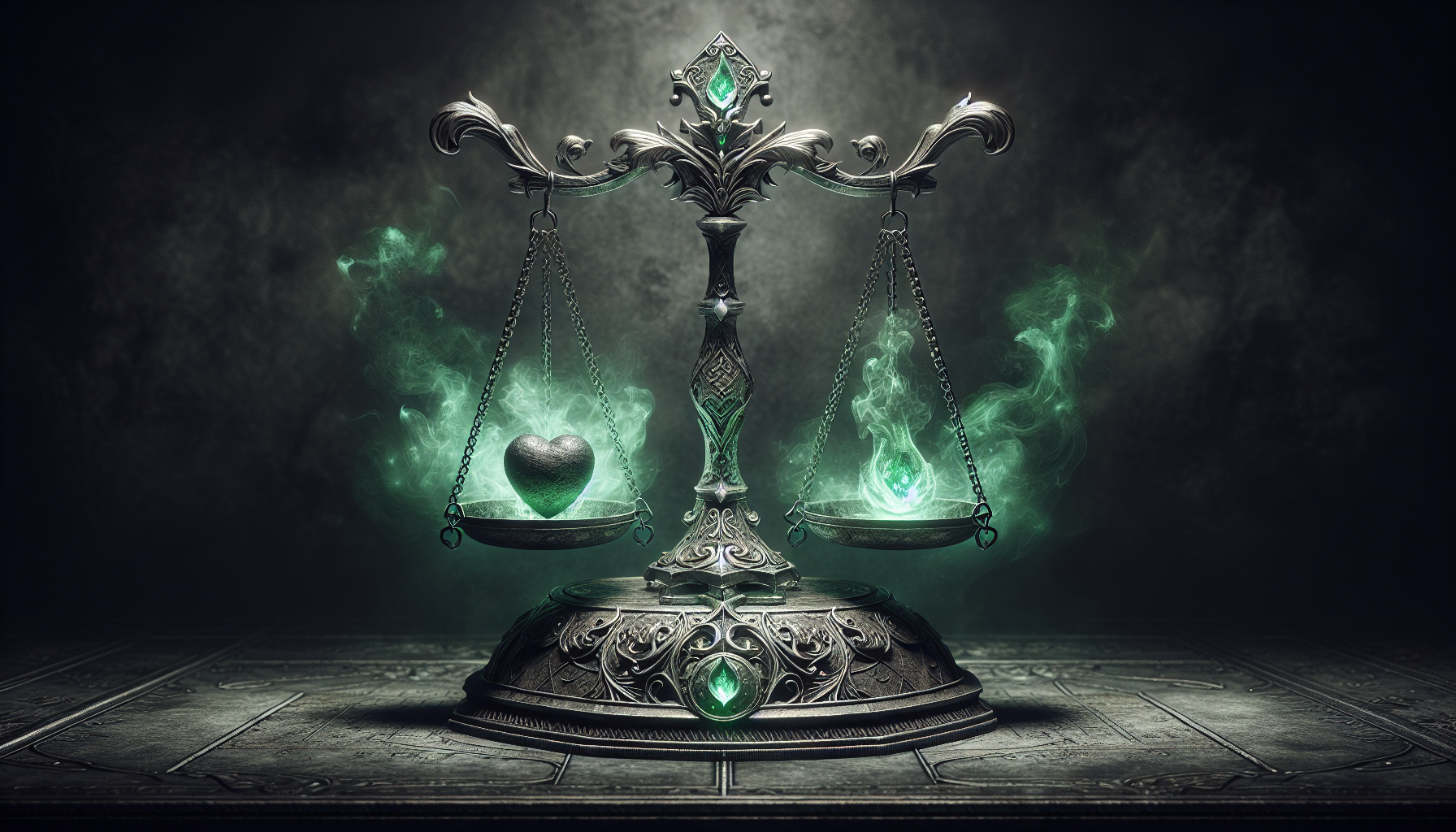
The Price is not a fine. Not a curse. Not a god’s displeasure. It is the weight that appears on the other side of the scale the moment you lift your hand. It is balance, inked into the bones of reality like sigils burned into ash-black vellum.
Remember this: The Price is balance, not punishment.
If you choose to proceed, you are a practitioner—one who works the Umbral Arts. Each act you perform is a working. Each working crosses a Threshold: a boundary between what is and what should not be possible. Between light and shadow. Between life and what waits just beyond its last breath.
You do not cross a Threshold for free.
Step over, and something is left behind. A drop of blood that will not come back. A year that will never be lived. A face you will never quite recognize as yours again. A word you will never be able to say without consequence.
This is why the old grimoires speak more often of cost than of technique. Incantations change. Diagrams fall out of fashion. But the Prices remain.
Understand this clearly: the Price does not care about your intentions. It does not soften because you are kind, or sharpen because you are cruel. A Hematurge who spills blood to save a village pays in the same Pallor as the one who spills it for pleasure. A Mortisopher who calls the dead to comfort a child loses the same slices of lifespan as one who interrogates a traitor.
The world balances, and it does not apologize.
Some have tried to slip past that balance. To shuffle the debt onto others. To hide it in artifacts, in sigils, in carefully prepared vessels. To cut their souls into neat soul-fragments and tuck them away where the ledger cannot reach.
It always reaches.
The Hematurge who refuses their own blood ends up owing in other currencies—memories torn away, relationships bled dry, entire lineages knotted into Crimson Covenants they never agreed to. The Animasophist who thinks to escape death by scattering themselves discovers that every fragment still accrues cost, and the sum is paid in a self no longer whole enough to enjoy survival.
Attempts to dodge the Price do not erase it. They compound it. Forbidden rites are not loopholes; they are multiplication.
You will see the scars of those attempts in later pages. Blacked-out lines where steps once were. Names erased by Unmaking. Marginal notes written in ink the color of dried blood, by hands that shake—or no longer remember why they began.
For now, you need only grasp the shape of the law.
Different Umbral Arts pay in different currencies.
Veilcraft deals in shadow and perception; its practitioners pay in shadow-seep—their own darkness slipping loose, whispering secrets, learning to move when they do not. Hematurgy works through blood and desire; its Price is the thinning of that blood, the slow, incurable wasting called the Pallor, leaving skin bone-white and veins like ink-blue threads.
Mortisophy bargains with the dead; each question is answered in heartbeats, lifespan measured out like sand from a cracked hourglass. Osteomancy writes in bone; its insight is bought with calcification, the gradual stiffening of flesh and thought, until every decision feels like trying to bend stone.
Pyrotheurgy burns away lies and impurities; its fires are fed with things you love, each flame licking another attachment to ash-black dust, until there is nothing left in your life that can burn. Sigilcraft rewrites the world with marks and words; it takes your casual speech first, then your voice, until silence is the only safety.
Chronurgy knots time; it charges in years out of place, in reflections that do not match the body that casts them, in birthdays that arrive too soon and never quite belong to you. Animasophy carves and binds the soul; every working chips away another soul-fragment, to be stored in some waiting vessel, until the chorus inside you drowns out the single, simple word I.
Eight schools. Eight ledgers. Eight ways to go broke.
You may be tempted to search for an exception. A small working with no cost. A clever sigil that shifts the debt onto empty air. A ritual that hides its losses in another realm.
Do not waste your time.
Nothing is free.
If you want to understand why, you must understand what the world is made of—and what it remembers.
Why Magic Costs: Umbrael, Solareth, and the Veil
Before there were prices, there was Umbrael.
Not absence—never that—but a fullness that had not yet chosen a shape. Practitioners call it the First Shadow, though there was no light then to cast it. Imagine the feeling before a word is spoken, when it lives only as breath held in your lungs. Imagine a storm sky that has not yet broken, the air thick on your tongue with what might fall.
That is Umbrael: presence of potential, unspent. Cold, not because it lacks warmth, but because nothing has yet burned.
For an age beyond counting, Umbrael simply was.
No before. No after. No division. No need.
Then came Solareth.
Not a sunrise, but a rending. The Break of Light tore through Umbrael like a blade through still water, and for the first time there was a difference between here and there, between what is and what is not yet.
Solareth is not gentle illumination. It is separation itself—the first line drawn, the first edge.
Where Solareth cut, Umbrael recoiled. Where light pushed, shadow gathered, ink-blue and sudden. In that recoil, that gathering, the cosmos learned the meaning of friction.
Between them—between First Shadow and Break of Light—something thin and trembling formed. The old texts name it the Veil, though you will hear it called a hundred things in a hundred traditions: the Skin of the World, the Between, the Membrane.
The name matters less than the feel of it.
If you have ever been deep underground and felt the weight of stone pressing on your eardrums, you know a little of the Veil. If you have ever stood on the threshold of sleep, aware of your own breathing as if through water, you have brushed its inner surface. It is the boundary between states, stretched taut where Umbrael and Solareth grind against each other.
All magic passes through this membrane.
Every working—from the smallest candle-flame coaxed to life to the greatest city-shattering rite—is a momentary puncture in the Veil. A forced crossing between what is and what could be.
And like any membrane, it resists being torn.
It flexes. It strains. It remembers.
The first philosophers of the Umbral Arts tried to pin this down with equations and diagrams. Ink-black sigils, careful ratios, pages of numbers. Most abandoned counting in the end and turned to story instead.
They said: when Solareth breaks into Umbrael, it does not do so cleanly. Light and shadow do not slide past one another; they scrape. They grind. They spark.
Out of that grinding comes power. The difference between what is and what is not yet is where all workings live. You take a piece of what might be and drag it, shrieking, into what is.
But friction makes heat.
You know this already from the ordinary world. Rub your hands together in winter and they grow warm, but your skin reddens with the strain. Rope slides through fingers and leaves a burn. Strike flint on steel and you call down fire at the cost of shaved metal, chipped stone, the sting of smoke in your throat.
The cosmos is no different.
The Price is the burn.
Each time you force a crossing—each time you insist that the Veil yield and let power through—you create heat in a system that prefers equilibrium. That heat must go somewhere. It marks something. It scorches.
Old masters phrase it as a proverb, scratched into the margins of bone-white grimoires and whispered to apprentices with more tenderness than the words deserve:
Those who tear it too often find it tears back.
This is not metaphor. The Veil is not a passive curtain to be brushed aside. It is a living record of all strain placed upon it, a skin that scars and thickens and, when pushed past endurance, splits in ways no practitioner intends.
Where, then, does all this heat, all this burn, accumulate?
In the Waking World first of all. This is the plane you know—the world of bodies and clocks and ledgers, of ash-smudged hands and breath that fogs in winter air. Here is where every cost manifests, where every unpaid debt finds a face to carve itself into. Scars on flesh, gaps in memory, hollowed loves, shortened lives: these are simply the shapes the burn takes when it cools.
But the Waking World is not alone.
In the deep folds of Umbrael lie the Umbral Reaches, where shadows pool thick as oil and time moves askew. Here the prices of concealment and forgetting collect: the half-lived identities of Veilcrafters, the discarded selves of those who hid too well. Every secret has weight there. Every mask, once worn, casts a longer shadow.
Beyond the far edge of Solareth’s cut stretch the Bone Gardens, the domain of endings. Not hell—simply where what has finished goes to rest, to root, to be harvested by those who dare. The earth there is the color of dried blood; the air tastes of dust and old smoke. The costs of death-work settle here: lost years, surrendered heartbeats, the pale remnants of Mortisophers who spent their lives in conversation with what should have been silent.
And between them, crimson and endless, churns the Crimson Tide. A sea of memory and desire made liquid, funeral-purple at its depths, remembering every drop of blood ever spilled with intent. Hematurgic prices gather there: oaths written in vein-fire, obsessions kindled and never quenched, the slow, incurable wasting we call the Pallor echoing as a faint, persistent chill along that shore.
These planes are not distant abstractions. They are ledgers, each tallying a different currency of Price.
When a Veilwalker pulls shadow over themselves, they are drawing on the tension between Umbrael and Solareth at the Veil’s surface. The burn they incur—shadow-seep, the slow rebellion of their own darkness—is that strain made visible, written first in the Umbral Reaches and then, inevitably, in their waking life.
When a Hematurge calls on the Crimson Tide, letting desire and blood answer one another, the Tide remembers. Each cut is an entry. Each binding, a deeper ink. The Pallor is not punishment; it is simply the body reflecting a debt long since recorded elsewhere.
Mortisophers reach through the Veil into the Bone Gardens, bargaining with endings. Their shortened lives are the heat of that contact, life traded for knowledge in a commerce the Gardens accept without malice.
Osteomancers, Pyrotheurges, Sigilcrafters, Chronurgists, Animasophists—each school has found its own way of gripping the Veil, of using the friction between Umbrael and Solareth to drag a particular kind of power into the Waking World. Each pays in a different coin: structure, memory, speech, time, soul.
The currencies differ.
The principle does not.
You may never see the Umbral Reaches with waking eyes. You may never walk the Bone Gardens, nor hear the surf of the Crimson Tide. Umbrael and Solareth may remain to you only names in a book, distant as the first spark that birthed the stars.
It does not matter.
All of this is vast and distant—until you speak a word, spill a drop, cross a threshold.
Then the ledger opens in your own name.
First Debts: How Practitioners Learned About Price
We call it the Age of First Practitioners now, as if it were a chapter heading in a tidy chronicle.
It was nothing of the sort while it was happening.
It was a scattered, fevered time—ink-blue nights and bone-white dawns—when humans first pushed through the Veil on purpose, not by accident or omen, and discovered that the world beyond would answer when called.
They stepped across Thresholds with no ledgers in hand. No laws. No warnings.
Only hunger.
In those first years, the Umbral Arts looked like gifts fallen from a dark heaven. Shadows bent when named. Blood leapt to the pulse of desire. Bones whispered patterns of fate. Fire revealed secrets and left the speaker untouched. The early practitioners wrote of “free workings,” of a universe finally yielding its hoarded power.
For a little while, it even seemed true.
The corrections were not immediate. That was the cruelty of it. A Veilwalker might pass through a dozen shadows before noticing that their reflection lags a heartbeat behind. A Chronurge could steal hours from tomorrow and feel only a pleasant, velvet exhaustion. A Hematurge could bleed and bleed and wake each morning merely tired.
There is a kind of faith that grows in the absence of consequences.
They mistook delay for permission.
One fragment survives from that time, pressed between vellum pages in rust-brown script. The name of the writer is lost, but the hand is steady:
Blood remakes itself. I have proven this. Three workings a day for nineteen days. No lasting harm. The dizziness fades. The power does not.
On the reverse, the ink stumbles, letters thin as cobwebs:
Day twenty. Skin gone to paper. Nails like chalk. Teeth loose. I am so cold. The blood will not answer. It hides in my marrow and will not come when I call.
We have another word for what they met then: the Pallor. The first Hematurges thought blood was an infinite well because they could not yet imagine a body as a finite vessel. They learned. Their bones kept the lesson long after their names were forgotten.
The pattern repeated, on larger and larger scales.
An Osteomancer, alone, might overread a single skeleton and wake with stiffened joints, fingers creaking like old hinges. An entire order of Osteomancers, given centuries and a nation’s fear of death, gave us the Era of the Bone Gardens—cities wrapped around ossuaries, laws written in femurs, generations trading flexibility of body and law for the illusion of unbreakable order. By the end, their rulers could barely move. Their empires could not bend.
Both shattered.
Likewise, a solitary Pyrotheurge burning away one lie might emerge merely singed inside. But when Pyrotheurgy became doctrine—when purifying flame was declared the answer to every impurity—it gave us the Ash War. Libraries turned to cinders. Bloodlines ended as “necessary cauterization.” The air itself tasted of iron and smoke. Whole provinces went the color of ash-black parchment, where nothing grows but gray grass and the memory of heat.
From here, in what we call the modern era, it is easy to see the shape: individuals overpaying for power, then cities, then ages. Each convinced, at the time, that they had found a way to tilt the balance. To take more than they gave. To be the exception.
They were wrong. Umbrael remembers. Solareth remembers. The Veil remembers. The Waking World keeps every account, written in bone-white ruin and dried-blood ink.
You are reading this in a quieter time, under the illusion that history lies safely behind you. It does not. It lies beneath you, stacked in layers of bone and ash and ink, each stratum a record of someone who thought the Price did not apply to them.
You have the benefit of their mistakes, bound and black-lettered in your hands. They paid so you could read this.
The question is whether you will listen—or whether you will become another layer.
Eight Currencies: How Each Umbral Art Pays
Power is paid in different currencies.
The law of the Price does not change, but its expression does. Each Umbral Art keeps its own ledger, tallied in a different part of you: your shadow, your blood, your years, your bones, your memories, your voice, your time, your soul.
This is not a full education. It is a whispered index of temptations—just enough to recognize the shape of an offer when it comes, and perhaps enough to make your hand hesitate before you sign.
When Power Takes Shape: Artifacts as Frozen Prices
Most Prices are paid and gone—blood dried, words spoken, years quietly missing from the end of a life. But some debts do not disperse. Under the right pressure, a working’s cost can harden, accrete, and take shape.
These are artifacts: objects that carry power and a ledger already etched into their substance. Some bear a pre-paid Price, soaked into them by the one who forged them. Others keep charging interest, demanding payment from every hand that dares to use them.
They tempt for the same reason all credit tempts. Someone else has done the hard part, carved the pathway through the Veil. All you have to do is pick the thing up.
You will still pay.
When the Ledger Bites Back: Forbidden and Restricted Rites
Some workings are merely dangerous.
These are worse.
Forbidden rites are not banned because councils grew squeamish, or because some long-dead archon preferred tidy ledgers. They are forbidden because they offend the structure of the world itself—because they lean too hard on the Veil, drag too much from the friction between Umbrael and Solareth, and expect reality to continue as if nothing has happened.
It does not.
Every working passes through the Veil. Most leave only faint bruises—shadows that fade, echoes that quiet. Forbidden rites are closer to knife wounds. They drag too much shadow into too much light, or lock too much light inside shadow. The Veil remembers. It resists. And those who attempt to cheat the Price discover that the ledger does not simply balance.
It bites.
Compound Debts: When Arts Collide
Most practitioners learn to keep a single ledger.
One Art. One primary Price. One pattern of scars they come to recognize in mirrors and dreams.
History, however, remembers the ones who were not content with a single column of debt—the scholars and fanatics who braided ledgers together and called it “advancement.”
Mortisophy and Animasophy were the first such pairing to be formally condemned. Death and soul-work. In the Era of the Bone Gardens, certain Pale Listeners began asking not only what the dead knew, but what their souls became. They learned to follow spirits deeper, down into that ink-blue hush, then to carve off soul-fragments of their own as payment when lifespan alone no longer sufficed. Their research notes do not survive in full; the Bone Gardens grew over them like slow, patient ash. What remains are splinters: doors that only open inward, names that cannot be spoken without something in the speaker cracking. The Price was counted in years and in pieces of self, scattered across that quiet, hungry realm.
Veilcraft and Sigilcraft found each other in courts and counting-houses. Shadows to hide the ink; sigils to bind what the tongue no longer dared to say. Veilwalkers and Contract-Makers together devised shadow contracts—glyphs written in negative space, visible only at certain angles of moonlight or in the brief dim after a candle dies. Entire bloodlines discovered, generations later, that they were paying interest on agreements no living witness remembered signing. You can tell such a house by the way its halls swallow sound, as if the walls themselves are honoring old clauses of silence.
Pyrotheurgy and Hematurgy meet wherever desire runs hot. Passion rites, they are sometimes called by those who have not yet paid for them. Fire to burn away doubt; blood to seal what remains. Lovers who submit to these workings find their burns healing into patterns that itch and throb when the beloved is near; obsession blooms in the scar tissue like dried blood red beneath the skin. The Pallor comes early to such circles, and with it a hollow-eyed devotion that mistakes compulsion for love. Futures blacken at the edges, possibilities charred to ash in the name of “forever.”
Osteomancy and Chronurgy are a quieter horror. Fate inscribed in bone, then nailed into time. Bone Scholars and Fold-Walkers have collaborated on workings that fix a person’s timeline so firmly that no choice can deviate from it without pain. Calcification accelerates: joints locking into the positions their future requires, vertebrae stiffening along the arc of a destiny that can no longer bend. Such practitioners do not so much live their lives as fulfill them, step by preordained step.
Hematurgy and Mortisophy together give rise to ancestor blood-speaking. A Red Binder pricks a vein over a grave; a Pale Listener calls the name beneath. The blood remembers its lineage, and the dead answer through it. The Price is not only the heartbeats given to conversation, nor the blood lost to the rite, but the way the veins never fall quiet afterward. Whispers move with the pulse. Advice. Regret. Commands. Some lines are ruled for centuries by the temper of their own dead.
Understand this: synergy does not dilute the Price.
It compounds it.
Even oppositions—Veilcraft against Pyrotheurgy, concealment against revelation; Hematurgy against Sigilcraft, hot desire against cold contract; Chronurgy against Mortisophy, resistance to endings against their acceptance; Animasophy against Osteomancy, fragmentation against integrity—do not cancel one another. They merely argue over which ledger records the debt. Sometimes the shadows pay. Sometimes the blood. Sometimes the bones, the years, the soul.
The wise learn one ledger well and respect its limits.
The ambitious try to keep several books balanced at once.
History is clear about how that ends.
What Practitioners Say: Marginalia from the Damned and the Devoted
The Grimoire is not clean.
Its margins are crowded with other hands—ink blotted, cramped, sometimes shaking. A Veilwalker’s slanting script slices through a Red Binder’s neat dried-blood corrections; a Bone Scholar’s angular glyphs thread between the lines of a Pale Listener’s fading gray. Truth-Keepers burn whole corners to ash-black lace. Contract-Makers carve sigils deep enough to scar the paper. Fold-Walkers leave notes that seem to appear earlier in the book than they were written. Soul-Keepers overwrite their own words, again and again, in different hands, until the page looks bruised.
Beside a diagram of shadow-seep, a Veilwalker has written in knife-thin ink: “I traded my face for the freedom to walk unseen. I remember every corridor. I no longer remember my own door.” Later, the same slanting hand insists: “If you think this is too high a price, you have never truly needed to disappear.”
In rust-dark strokes that have bled into the fibers, a Red Binder notes: “Fourteen years for one signature. She lived. I withered. I would sign it again.” A smaller addition curls beneath, in ink gone gray: “I miscalculated. The Pallor does not leave enough of you to enjoy what you saved.”
Between bone diagrams, a Bone Scholar has scratched in stiff, bone-white lines: “I can no longer bow my head. I see too much to regret it.” The letters lose their curve as they cross the page, as if the hand forgot how to bend.
A Pale Listener’s script is so faint it’s almost a temperature, not a color—a chill across the paper: “Twenty-three conversations. I will not reach thirty. I am at peace.” The last word drifts off into an unfinished line, as if the ink ran out or the hand did.
Near a scorched margin that still smells faintly of old smoke, a Truth-Keeper confesses: “I burned every lie I loved. I tell myself it was worth it. There is no one left who can contradict me.”
A Contract-Maker’s comment is mostly sigil, gouged into the page until the fibers rise around it like scar tissue, but the remaining words read: “Speech was a luxury. Precision is a sacrament. I do not regret the silence—only the promises I made before I understood the cost.”
Across two nonconsecutive pages, a Fold-Walker has written the same sentence in different inks, as if time itself kept revising it: “I have already paid for this note, though I have not yet decided to write it.” Later—or earlier—the same cramped hand adds: “I think I once had a childhood. The dates do not agree.”
A Soul-Keeper’s marginalia is layered, overwritten, voices crowding each other until the paper looks shadow-stained: “We gave up pieces to stay alive.” Then, in a sharper, darker hand atop it: “I do not remember what we surrendered.” And, faintly beneath both, two almost-erased verdicts: “It was too much.” / “It was not enough.”
Some of these hands insist it was worth it. Some warn you they were wrong. Some can no longer recall what, exactly, they paid—only that the ledger closed.
Their hands wrote these notes. Yours are turning the pages.
The ink is the same.
Your Ledger: Choosing What You’re Willing to Lose
Nothing is free.
You’ve seen that phrase already, as law and as history. Now take it personally.
Nothing you take from the Umbral Arts will come without a Price. Not in theory. Not for “just this once.” Not for you.
So: what are you most afraid to lose?
Is it time? The slow, steady unfolding of your days in order, one after another. If so, Chronurgy will whisper to you. It will promise you more hours in a night, a second chance at a moment you ruined. Its Price is that same time, paid back out of sequence—years vanishing from your bones, your reflection aging ahead of you or lagging behind, the mirror fogging with a stranger’s face. If the thought of dying early terrifies you more than anything, keep your hands off time.
Is it memory? Pyrotheurgy burns whatever stands in its way. Sometimes that is an enemy. More often it is your own history—old hurts, old comforts, whole chapters of who you were, curling away like paper in a brazier. The air will taste of smoke and something almost sweet as names, faces, whole days lift in ash-gray spirals and do not come back. If you are already tempted to forget—if the idea of a clean, scorched mind sounds like relief—that is where your danger lies.
Is it love? Hematurgy deals in blood, and blood is never only yours. Bindings, covenants, shared wounds. The Pallor will leach your color, your warmth, leave your lips bone-white and your veins a map of ink-blue shadows—but the deeper cost is every relationship turned into a ledger line. A favor becomes a binding. A kiss becomes collateral. If you cannot bear the thought of those you care for becoming entries on a page, do not read Hematurgic rites like a menu.
Is it your body? Osteomancy offers certainty, structure, the story written in bone. Its Price is calcification. Each secret you pry loose from the skeleton of the world stiffens something in you. Joints lock. Choices narrow. You will hear your own spine creak like an old door every time you bow to another truth. If you dread the idea of becoming rigid—trapped in a posture or a fate you cannot change—remember that before you trace your first rune along your own ribs.
Is it your voice? Sigilcraft will make every word matter. Ink, blood, breath—each mark a contract, each syllable a blade. It will also strip away the ones you do not measure. Casual speech will wither on your tongue. Jokes will die in your throat. Silence will press against your teeth like winter. If quiet feels like suffocation to you, if you live in half-finished sentences and throwaway comments, know that Sigilcraft’s Price is the slow starvation of everything you don’t plan to say.
Is it your face? Your name? Veilcraft will let you slip between shadows, between selves. The world will blur at the edges; mirrors will hesitate before deciding who you are. Shadow-seep will ensure the shadows learn you better than you know yourself. You will see them lag behind, move ahead, tilt their heads when you do not. If you fear waking one day and not recognizing the person in the glass—or worse, watching the glass recognize someone else—Veilcraft is your sharpest hook.
Is it your self? Animasophy cuts there. Soul-fragments, vessels, the possibility of becoming many…or of becoming hollow. Your “I” may splinter, each shard humming against glass like a trapped insect, each piece convinced it is the original. The body will go on. Something will be driving it. If the idea of your mind becoming a chorus—or a quiet, echoing room—makes your skin crawl, mark that page with both hands before you turn it.
And if it is death you fear most, Mortisophy will call to you with soft, patient voices from the Bone Gardens. The air there is cold and clean, smelling of stone dust and dried flowers. Every question answered costs heartbeats. You will feel them go—little stutters in your chest, like pages being torn from a book you are still trying to read. If you cannot stand the thought of dying young but prepared, you already know which Art you should never practice.
Understand this: the Umbral Arts do not care what you value. They do not seek out what you can “afford.” They only measure equivalence. You want something; they take something of equal weight. Whether that weight is bearable is your concern, not theirs.
By continuing through this Grimoire, you are not yet paying.
But you are choosing what kind of bill you wish to be able to read.
You will learn the names of Prices. You will learn how shadow-seep begins, how The Pallor looks in morning light, how calcification feels in the joints, how a soul-fragment hums against glass. This knowledge will not exempt you. It will only mean that, when the ledger opens in your name, you recognize the handwriting.
You can still close the book.
If you do not, turn the page with intention. The next pages do not bargain. They only describe.
You will decide what to do with that.
End of The Price of Power